
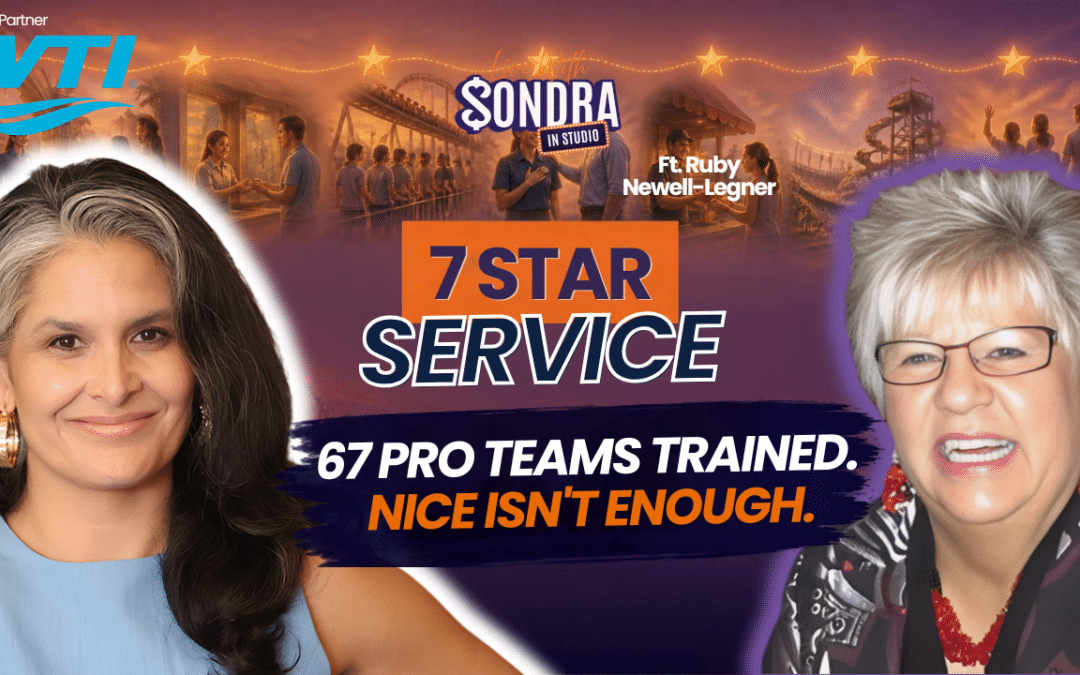
Live With Sondra In Studio
7-Star Service: Designing Experiences Guests Remember
Ft. Ruby Newell-Legner, Fan Experience Consultant at 7 Star Service
Brilliant rides don’t guarantee repeat visits. Experiences do.
Most operators invest millions into hardware—but leave the “human system” to chance. Ruby Newell–Legner has spent decades proving that service can be architected just as intentionally as a slide tower or a wave pool.
“It’s so important that in our businesses we remember that business is about people, from the team all the way to the guests and the people who are having these experiences.”
– Sondra, on why the real product is people, not rides
Overview
Ruby Newell–Legner is Fan Experience Consultant at 7 Star Service, known in our industry as the Fan Experience Consultant. She has delivered:
- 4,000+ programs
- In 26 countries
- Across 238 amusement parks & attractions
- And 67 professional sports teams, plus mega–events like the Super Bowl and the Olympics
In this in–studio conversation, Ruby and Sondra break down how to engineer service so that:
- Staff aren’t just “nice”—they’re deliberate experience–makers
- Leaders don’t sabotage culture from the top
- Guests leave with stories strong enough to become “Thanksgiving highlights”
This isn’t generic customer service training. It’s a field manual for GMs, owners, and senior leaders who want service to show up in revenue, loyalty, staffing, and reputation.
1. From “Nice” to World-Class
“If great service isn’t about being nice, what actually creates a world–class experience?”
Ruby draws a hard line between being nice and designing experiences:
- “Nice” is the entry ticket, not the differentiator.
- World–class service is intentional, consistent, and measurable across every touchpoint.
- The real product is the emotional arc from arrival to departure—not just the ride list.
Operators who stop at “hire good people” end up with inconsistent guest journeys and no way to scale what’s working.
2. Cycles of Service: Mapping Every Moment
Ruby’s signature framework, Cycles of Service, turns vague “good service” into a blueprint:
- She builds a cross–department “shining star” committee—hand–picked frontline leaders in service.
- Together, they map every step of the guest’s journey: pre–visit research, ticketing, entry, amenities, exits, and everything in between.
- For each step, they define specific standards: what staff should do, say, notice, and solve.
Results:
- Service becomes trainable, coachable, and auditable.
- Departments finally see how their actions impact the guest and each other.
- “Wow moments” stop being accidents and start being embedded in the system.
3. Leadership as the Hidden Service Lever
Most calls Ruby used to get were: “Can you fix our frontline staff?”
Her answer: not without the leaders.
Key leadership stories:
- A CEO who walked the venue without acknowledging staff. One simple assignment—“say hello and use their names for a week”—completely changed how the team experienced him, and they noticed within 24 hours.
- A new leader who spent her first weeks interviewing every employee, then stood up in a team meeting and, with no notes, named each person’s strengths and contributions. Immediate trust. Immediate buy–in.
Core idea:
If leadership doesn’t model hospitality, visibility, and respect, no amount of frontline training will stick.
4. Building Problem Solvers, Not Dependence
Ruby focuses on systems that force better thinking instead of more escalation.
Two practical plays:
- The “Two Solutions” Rule
A small sign on her office door read:
“You can bring any problem you want to me, as long as you bring two solutions.”
Staff would literally walk up, read it, step away to think, and return with ideas. Over time, this built a solution–oriented culture.
- “What do you think we should do?”
When calls came in all day with questions, Ruby coached leaders to answer with this first.
Most staff already had the right answer. They just needed permission and confidence.
Outcome:
Teams start innovating at the edge, GMs become less of a bottleneck, and guests get faster, better resolutions.
5. Micro–Systems That Change the Floor
Ruby doesn’t just teach concepts—she collects micro–tactics that change daily operations:
- Silent Manager Signal
In one restaurant, staff put a subtle hand on their heart when they needed a manager. The manager scanned for the cue and stepped in—without any guest noticing distress. - Staff get backup instantly.
- Managers stay on the floor, not buried in the office.
- Guests experience calm, seamless support instead of visible chaos.
- Everyday Recognition as Culture Architecture
Leaders who actively look for what’s working, name it publicly, and tie it to values create a culture where: - Staff feel seen, not managed.
- Service standards feel aspirational, not punitive.
These tiny systems are what make service reliable on a Saturday in July, not just in a training room.
6. Becoming a “Thanksgiving Highlight”
Ruby’s litmus test for a truly great operation:
“If your venue creates the highlight that they share on Thanksgiving Day, you’ve done a great job.”
She calls it the Thanksgiving conversation:
- Once a year, family and friends gather and ask:
“What was your favorite thing you did this year?” - If a guest’s story is:
“You won’t believe what happened at this park…”
then your team has done more than entertain. They’ve created a core memory.
How you get there:
- Design the moments between the first greeting and the final farewell.
- Hire for heart and imagination.
- Train leaders as aggressively as you train frontline.
- Give staff frameworks (like Cycles of Service) that let them turn kindness into craft.
7. What Executives Should Do Next
For GMs, owners, and senior leaders, this episode is a prompt to:
- Audit your guest journey.
Ask: Where, specifically, do we rely on “nice people” instead of a designed standard? - Put leadership in the frame.
Decide what behaviors—from walking the floor to knowing names and strengths—will be non–negotiable. - Install one “thinking system.”
- A “two solutions” rule
- A silent help signal
- A shining–star committee
Pick one, implement it, and measure how it changes decisions and morale.
- Aim to be a story, not a stop.
Reframe your goal from “no complaints” to:
“Did we create a story someone will want to tell?”
Watch & Listen on the Go!
Listen to Live with Sondra In Studio on your favorite platforms including: LinkedIn, YouTube, Instagram, TikTok and X!


In-Studio Series Partner: Water Technology, Inc. (WTI)
Standout experiences don’t happen by accident. They’re designed that way. So if you’re serious about building something people talk about, film, and come back to, go to WTIWorld.com and see what Water Technology, Inc. is doing around the world. Be a destination.
#YourWorldinWater
Episode Transcript
Designing 7‑Star Guest Experiences
[0:00] Once we get a good feeling of all the steps that the customer goes through, that we want to make sure that each employee does to meet the needs at that step. So it becomes very measurable, and it becomes something that is elaborated on. That’s where the creativity comes in, the wow moments come in.
[0:24] They’ve done the, the shining star of an employee who’s showing potential and wants to be a leader. So it really teaches people along the way, develops their awareness. It also teaches departments about other departments. They’re helping people make these great experiences. Right. You kind of remind me with your friend saying, “I can’t go to the grocery store without thinking about the cycles of service,” which is hilarious, ’cause I, I find myself being in a very similar boat.
[0:50] Welcome to Live with Sondra. I’m your host, Sondra Shannon, and today we’re diving into one of the most critical drivers in the experience economy, how you design your service. Because it’s no longer enough to build something big. It has to be intentional, consistent, and built to perform at every touch point.
[1:10] And today’s guest is someone who has spent her career doing exactly that. Ruby Newell-Legner is the president of 7 Star Service, delivering over 4,000 programs in 26 countries, working with 238 amusement parks, 67 professional sports teams, and global events like the Super Bowl and the Olympics. She’s known as the experience architect, and today we’re breaking down what that exactly means for operators.
[1:42] Ruby, welcome to the show.
[1:48] All right, Ruby. My first question for you is if great service isn’t about being nice, what actually creates a world-class experience, and what are organizations doing that are not designing that as well as they could be? Wow, start off with a big question, would you? I mean, that’s like a whole book in itself.
[2:11] Just kidding. It’s a great question. And, you know, a lot of people do think being nice, that’s- that’s the start of it. Obviously, we do need employees who are nice and greeting the guests, but the experience is what it’s all about. So I like to hire people that are, you know, nice. They know the, how to be polite, but then they also have an i- uh, an imagination, and they know how to take that experience and make it a wow experience.
[2:37] And that depends on your culture, how you’re training your staff, and preparing them for those moments. Well, you know, one thing that I think is really interesting about the nice word, one of my mentors said to me once, they said, “Sondra, do you know what the word nice actually means? Do you know what the- No, I don’t.
[2:55] Tell me … derivation?” Stupid. Really? Yes It equates to that, huh? It is. That’s what, uh, it, that’s what it originally meant, and then over time- Yeah … it’s taken on this new meaning. But it actually made me stop using the word as when I am talking about myself, right? Mm-hmm. And I’ve switched it out to kind. So I think it’s interesting- Mm
[3:16] that we’re starting this conversation realizing that nice- Yeah … isn’t enough, right? Not enough, definitely. If you want them to be loyal and come back, you gotta have a, they have to have an experience. That’s right. Well, that’s kind of brings me to my next question. You know, so many organizations think that hiring good people is enough, but from our conversations, I know that hiring good people is not enough, and I’m curious what you think about hiring good people and how organizations can get around that.
[3:47] Well, good people is definitely a good start, and however you define that and what your, and really important elements that you are looking for are included in that good people. And then clarifying all your expectations, sharing your values, living your values, being a leader that allows them to grow and to prosper and contribute to the experiences, that’s when that good people takes on a whole new meaning, and if you give them the tools to do that and you help them grow, it’s amazing what a staff member can do, um, if they’re hired right and then trained right, and they understand their role in the whole economy of getting people to enjoy the experience and to come back and tell their friends.
[4:35] Yeah. Well, with regards to hiring good people, I know that one of the things that you’ve experienced, ’cause you’ve had a… I mean, one, you have so much knowledge in this industry. You’re just one of our treasures, and- Thank you I’d like to kinda go back just a bit- Okay … to, like, how you started in the industry, who you are, so the audience has a- Oh, sure
[4:58] really good picture. Because these questions are gonna get harder as we go, and I actually think we’re gonna be hitting on some really hot topics right now. Mm. But I know that if everyone doesn’t know you, they should know you, and I’m very glad that I know you. Well, I’m glad I know you, too, and I treasure our friendship.
[5:15] I feel, I feel the same way. But I would love, Ruby, for you just to tell the audience today, you know, who are you? What’s your story? What’s my story? Well, maybe there’s a little part that you don’t know, in that my mother was a manager of a restaurant. So every day going to swim practice and her picking me up in the evening after a long day at the pool, she would tell me what had happened at the restaurant and how she solved it or how a challenge that she was having.
[5:41] And so I had customer service training from, you know, the, the age of six. Wow. Like way back then. And so all those years really created my first opportunity to have the background that I have. The second opportunity came when I decided to be a swim coach, and I was a competitive swimmer for 17 years and then a, a coach for 20 years, and I absolutely loved it.
[6:06] I went to college to get a coaching degree, and that was what really- It was my, it was my big, my big goal. And when I was finally coaching an age group team in the evening and a high school team in the morning, and I just loved it. And then I became allergic to the pool air, and the doctor said that if I wanted to get rid of my sinus headaches, I had to quit my job.
[6:27] And I’m like, “No, you don’t understand. I, I- Yeah … that’s just who I am.” So my identity had to change quite a bit, and during that process, I went from aquatic facilities management over to recreation facilities management, and I really liked it. And my headaches went away. I, I didn’t have the, the, the nonstop throbbing in my head, and all of a sudden I could think straight, and I just loved the learning of the training of the new staff, and that built into starting to do training myself for other organizations.
[7:02] And I did about 200 programs for free because I just wanted to get used to breathing in front of people, and that’s always hard when you’re learning how to speak. And, uh, that turned into… You know, I had a mentor who, uh, was part of the, uh… He worked at Honeywell, and his two colleagues that he worked with, they happened to be, uh, retired and went to work for the Denver Broncos Football Club.
[7:26] And so that brought another opportunity because they asked him to come do customer ser- service training and they said… He said, “I don’t do it, but I know somebody who does.” So he introduced me, and we did three years of training before they opened up Invesco Field at Mile High. And then the other teams came, and I started doing a lot of training for, uh, s- professional sports teams.
[7:48] I have 67 that I’ve worked with so far. And then of course, all along that I was working with water parks ’cause of my aquatics background, and then amusement parks. IAAPA became a big part of my, my role. And I don’t know if you wanted that long of answer, but that’s- No, I, I- … that’s kind of the journey that I’ve been on.
[8:05] I wanted that long of an answer. I, I love getting to know you, and I didn’t know that little piece about your mother, so that was really cool. Yeah. I’ve, I’ve heard a, I’ve heard so many parts of your journey, and I love, I love hearing about it. I don’t know if I ever told you I was the manager of the swim team.
[8:20] No way. Tell me. And I told you that. Tell me. And the, and the dive team. Wow. Where? I, and I did the announcements for the dive team. In Utah. My last two years I spent in a little- How? … tiny town, uh, a mountain town in, in Utah, so very similar to Colorado- Yeah … where we’re at right now in terms of the mountains.
[8:37] But, uh, m- I, I mean, our mountains are not as big. I’ll give you, I’ll give Colorado that for sure. But, uh, yeah, I was in a little mountain town and, and I loved swimming, but I, you know, you know me. I love- Do lots of things, yeah … leadership and management. Yeah. Mm-hmm. And, and I remember I walked up to the swim coach and I’m like, “I don’t wanna be on the t- team.
[8:58] I wanna, like, help them win. How do I do that?” And he was like, “Well, you could be the manager.” Wow. I didn’t even know that was a thing. Wow. So that was my start of- of managing the swim team and, and the rest is history, but it certainly didn’t ever get into anything, uh, it didn’t move me into this industry, but it- Yeah
[9:19] it, it got me some of that experience in leadership that I think, um- And motivation. 100%. You know, it’s, it’s another thing we have in common. You know, we, we can see what motivates employees, and when you see that and you feel that and they feel that and they tell you they feel that, then it’s a whole different world, and that creates that culture that creates those experiences, so.
[9:39] Yeah, and I think, I think talk- speaking of leadership, you know, one of the questions I have for you, because I know sometimes we’ve talked a little bit about the team and the employees that are helping to create experiences that bring people back, but I know one of the things that you’ve bumped up against in your career and one of the hard conversations you’ve probably had to have with leaders or leadership is training the leadership team.
[10:06] It’s almost, if not more important than training the team, and I’d love to hear your thoughts on that. Or even, uh, this is selfish because I need to know this as well. How do you go in and say to a CEO or the leadership team, “I think you’re the one who needs the training”? Well, I’ve had to do that a couple of times, and I think that it’s not one of those first conversations, obviously.
[10:33] You get to know them and, um, I’ll give you one example, that there was one individual who was very high up in the organization. Actually, he was the top of the organization, and he was very, um, he, he didn’t make the staff feel important at all. Matter of fact, he totally ignored them. So he’d walk through the venue and just kind of look down and never have eye contact and never shout at them or, you know, like hello or anything.
[10:59] And so I had a conversation with him and I said, “So what, what’s going on in your mind when you’re walking through the venue?” And he says, um, “Oh, you have no idea all the things that I… My job is so big and so important, and so many people dependent on me, and I’m thinking about all the things I have to do.”
[11:14] And I said, “Well, I wonder how that feels to the staff when you walk through the building without acknowledging them.” And it kind of, it really shocked him. It really truly shocked him that he’d never really thought of that. And I said, “Do me a favor, and would you just, for the next week, when you’re walking through the building, would you, um, just stop and, and say hello to them and talk to them?
[11:34] They have a name tag on. It’s easy to say hello and, and ask them how they’re doing and just, just see how, how that goes.” And he kind of looked at me like, “Why? But okay.” And he did, and, uh, the people who had complained to me about him, um, did that, that phone call within 24 hours to me, “What did you do to him?”
[11:54] I said, “I just put the opportunity in front of him.” And I think that it was a good way for him to learn and me not to feel like I was telling him, ’cause he’s not the kind of guy you could tell what to do. But it was kind of like I was asking him a favor just to try it. So that seemed to work. I wouldn’t think it would work with everybody, but it seemed to work that time.
[12:15] Yeah, I actually really like that tactic. You know? Just try it out. Yeah. You know, see what, see how it feels, and see how people react to you. Did he notice that people reacted to him differently? You know, I didn’t talk to him again after that. I, I wish I would have. I, I was finished… It was towards the end of my stint with them, and, uh, but I bet…
[12:36] It, there was such a, a shock with the people who called me and told me. You know, “What did you do?” Yeah. And I told them, “Just made a suggestion, and, and he did.” Yeah, you got that feedback, so that’s- Yep … definitely says it works. And, and I, I’m a big believer that we should be training every day. I mean, you’ve been to my GT Summits, and you know- Yes
[12:56] that we talk about that, and that’s actually one of the reasons we started the event, was so that we could help people train in new and different ways and get, get exposure to people like you. Yeah. You’ve been a part of that for the last couple of years- It’s been wonderful, too … actually since the beginning.
[13:12] I’ve learned during that process as well. It’s great to get right beside the, the customers that you serve, too, and find out what their needs are. So I’ve enjoyed it very much. Yeah. I’ve really, I, I’ve really enjoyed having you there. I think that, uh, I know how lucky we are to have you there, and I learn from you every single time, but also from the other speakers in the room.
[13:32] Mm-hmm. And that’s, that’s really always been a very crazy interesting part of you that I, I wanna mention on the show today. I mean, you’re not only teaching people how to create these amazing experiences and how to understand what hospitality really means, but you’re also- this amazing speaker. In fact, you invited me to the- You made me be blessed What, what, what was the, what was the holiday?
[13:54] It was like the speakers- Oh, that was Professional Speakers- … professional speaker … Celebration Day. Celebration Day. Yeah. I really appreciate you taking me out to that because I, for one, know how much a speaker can change your life. I, I, I can think of at least five on one, uh, right now that have changed my life.
[14:13] But for you, you’re also… Is it the global? It’s a global speaking federation, Global Speakers Federation, and I was… I just served as president for a year, just finished, and I’m about halfway through my immediate past president role before I’m done on the board. And how many countries did that take you to?
[14:35] So I traveled to 20 countries, and part of that was with clients. Like, um, I go to the Bahamas to work with Perfect Day at CocoCay, Royal Caribbean Cruise Lines, and, um, but it was such a fascination for me. I love to travel, and the 20 countries, when you can, you know, you’ll be in Saudi Arabia one day, and I was in India the next day, and then flew home and went to France, and it was just, it stretches you to learn how other people live, learn what words are the same, and even in the English language they’re different.
[15:08] In the UK I learned so many words that it’s just hilarious. They, they, they call them the same something totally different that is something in our, in our English. So, um, it was fascinating, just fascinating. Yeah. That’s amazing. I, uh, I too like to travel, and I’m gonna get to experience Perfect Day at CocoCay here- Ooh, yep
[15:28] in a couple weeks for the first time. Oh, uh, tell me how it goes. I’m definitely gonna tell you how it goes. I’ve, I just wish you were there, you know? They closed that one out fast. Yeah. I had to get on that event with IAPA pretty fast, but- Yep … it was, uh… I’m really looking forward to it. Um, and also looking forward to, to the experience and, and even kinda seeing some of your work, right?
[15:51] Sure. That, that you get to… I, I, I, I’m curious how that feels when you get to go to an experience where you hear from people what those experiences are like after, what do you say, before and after Ruby. What’s the after experience feedback that you get? Or what are, what do you think is the most-impactful thing that happens after Ruby?
[16:14] Well, I’ll, I’ll quote one of my favorite holiday cards I got a few years ago, and it was a, just a simple note that says, “Happy Holidays and Happy New Year, and thank you for breathing life back into our building.” I mean, I, it just touched me. You know? Yeah. It’s… I think that people think that it’s the building or the experience or the how tall the slide is or, you know, how fast it is or how many different games they have or it, how many rides.
[16:44] It, it’s, it’s all about the, the people, too. The people contribute to the memories. And the things that happen between the friendly greeting and the fond farewell, those are the things that create the memories. And then of course, when you round it up and tie a bow on it with the friendly greeting and the fond farewell, then they go home and they…
[17:04] I, I call it the Thanksgiving conversation. I know not every country has Thanksgiving, but the beauty of the Thanksgiving conversation is you usually have people you haven’t seen for like a year, since the last Thanksgiving dinner, and everybody gets together and they ask for highlights. And if, if your venue creates the highlight that they share on Thanksgiving Day, you’ve done a great job.
[17:26] Yeah. And I believe that that’s the thing that’s the most important is that if they’re willing to, “Oh, you won’t believe what happened. This was so awesome, and we did this,” and, and sometimes you become part of that story, then, then you’ve done well. Yeah. I actually heard this amazing story. Um, it was from one of the Dollywood parks.
[17:45] I can’t remember which one it was, but they had a, uh, a, a guest with special needs that would come frequently. Mm-hmm. And there were employees that always said hello, remembered, I think it was her, her name. Mm-hmm. Uh, but whoever the guest was, they, they recognized her, and the family, you know, just really cherished that this was a- Mm
[18:09] part of the experience. ‘Cause here, I mean, I’ve been- Oh … to Silver Dollar City. This is some of the best rides ever, right? But for them, it was that connection that they were having with people. And think about how many people appreciated that. The child, obviously, and then the parents, and then how many people they told about it, and the feeling that they got, and it really does make a difference, and that word does travel.
[18:35] Yeah. I think that travels fast, right? Mm-hmm. When people feel- Yep … at home, and you make them feel at home, and part of the experience, that you’re adding to that experience. Mm-hmm. Well, we talked a little bit about what that looks like, but I, I know your cycles of service. It, it- you’ve, you’ve, you’ve, you’ve taught some of that to us at- Mm
[18:58] uh, events that I’ve been to where I’ve been able to see you speak, but then also at our GT Summit, and I’m curious, for our audience, you know, would you mind just kind of elaborating on kind of what that is and how that helps a business? Happy to do so. The way it usually starts is I get a committee together that are your, your, your department’s best shining star in customer service, and it’s, it’s an honor to be on this committee.
[19:24] And as they go through the process, they, they get chosen. Uh, the, the manager, we have a process that the manager actually goes out and, and hand picks them and, and says why they were chosen, so it’s an honor right from the beginning. And then we work diligently, and usually I get one or two representatives from every department.
[19:43] I just did a, a very large group, and we did two representatives from each department. And we take them through a process where they acknowledge all the steps a customer takes through the eyes of a customer. Some people call it a customer journey. I call it cycles of service. And so there’s a worksheet that we have.
[20:03] It’s two columns. On the, on the right side is a column that says, “This is the step the person goes through as they’re preparing to come see your venue.” They might call, they might go on a website, they might, uh, um, hear from somebody else, and then they go to, to buy a ticket. All the s- I mean, every single step.
[20:24] And then of course, whatever amenities the, the facility is offering, going through those steps as well, or a special event. And once we get a good feeling of all the steps that the customer goes through, then we go to the second column. And on the second column, it’s the standards that we want to make sure that each employee does to meet the needs at that step.
[20:47] So it becomes very measurable, and it becomes something that is elaborated on. That’s where the creativity comes in, and that’s where the, um, the wow moments come in. And if a person does that, um, then they have- they’ve, they’ve done everything right. They’ve done the, the shining star of an employee who’s showing potential and wants to be a leader, and wants to be, you know, moved up and get that promotion or a raise.
[21:14] So it becomes not only a tool to he- to develop their awareness, but because we meet as a group, sometimes they get to hear what other departments go through. One of my favorite stories was, um, when the day we were all together, and the marketing team for the Orlando Magic was sharing their cycles of service, and they…
[21:37] Everybody in the room just, their, their jaw dropped when they said that after they, you know, create a marketing piece, it g- has to be approved by seven people. And everybody went, “What?” No wonder it takes so long to get a marketing piece out. But we had no idea. So it really teaches people along the way, develops their awareness.
[22:00] It also teaches departments about other departments. And in the meantime, the two representatives are going back to the, their department and teaching people and making sure they got all the things. So it, it, it’s a really a big team-building event as well as a- an awareness. And because people It, it raises their levels of awareness so much that the people really kind of…
[22:28] Actually, one day I got a phone call from another client, and she says, “Ruby, you warped me for life. I can’t even go to the grocery store without thinking cycles of service, and what… If somebody is rude, I, I can already identify what they missed in the cycles of service.” And I’m like, “No, that’s a good thing.”
[22:44] And she goes, “I know, but my mar- my brain is going wild.” But it’s what I do. We’re going to take a quick moment because conversations like this just don’t happen by accident. Our Live with Sondra series brand partner, Water Technology, Inc., is helping operators around the world turn vision into fully realized aquatic experiences.
[23:06] From early concept to master planning to design, engineering, and project execution, their team brings together architects, engineers, designers to build environments that are intentional, immersive, and built to perform. What I love about WTI is this: They don’t just design water parks, they design how people experience them.
[23:29] Every detail is thought through from guest flow to water quality to the emotional connection a space creates. Because great experiences don’t happen by accident, they’re engineered. So whether you’re building something new or reimagined, this is the level of thinking that separates good from unforgettable.
[23:49] You can learn more about WTI at wtiworld.com. All right, let’s get back into it Yeah. Well, you’re making, you’re helping make people, or you’re helping people make these great experiences Right You know? And, and that kind of leads me… I mean, you kind of reminded me with your friend saying, “I can’t go to the grocery store without thinking about the cycles of service,” which is hilarious, ’cause I, I find myself being in a very similar boat- Uh-huh
[24:16] being in hospitality when I go to different businesses, and I can recognize where maybe there could be improvement or where they’re doing it really well. Right. Actually, that’s probably what sticks with me the most- Right … is, oh, I’m gonna take that and bring it back to our- Right … industry. But, um, yeah.
[24:34] I’ve got one of those that I’ll share with you. We were at a restaurant couple years ago, and it was a really… It was gorgeous. They had these beautiful paintings and these big arches, and I, I was asking the, the waitress about, um, who, who did the art. And, and she said, “Um, I’ll get to that in just a minute,” you know, da, da, da, and she goes on and gets our order and everything.
[24:56] And suddenly, the manager appears, and he said, “I understand you had a question?” And I’m like, how did she do that? You know, ’cause we- Yeah … she, it was like s- there was no turnaround. There was no anything. And, and she says, “Well, we have this thing that if we need a manager, we put our hand on our heart. And it’s n- it’s just, it doesn’t look weird, but, like, when you were, I was taking your order, I had my hand on your heart, on my heart, and, and, um, my manager saw that, so he came over right away.”
[25:27] So I’m like, “I love that. I gotta take that- Yeah … and teach that too.” It’s so simple to have some kind of cue that, hey, I need help, and it could be, you know, the manager comes over, and he doesn’t know if it’s bad or good, but he’s ready to jump in, and whatever it was. In my case, it was just a question. Yeah.
[25:45] But also, I think because the manager is looking for that feedback from their team, it’s probably keeping them out and engaged more too. Oh, absolutely. ‘Cause you have so many managers, especially, I mean, I’ve had, I’ve had some guests on this show that have mentioned, you know, some of the better operators and managers of parks typically are those that are getting out and seeing what’s happening in the parks.
[26:07] Correct. And so for that manager, that manager is probably likely out seeing what’s happening- Yeah … in a restaurant in a capacity that- Some managers don’t see. I worked in a restaurant. Let me tell you, my manager wasn’t out there watching to see how we were doing. Yeah. And that makes a big difference in the experience, not only for the guests, but also for the team- You bet
[26:28] in knowing that you have their back. You bet. And- Helps them, you know, if they have, they have a difficult situation, they can get help right away, or in my case, it was just a question that needed answers, so it was good. Well, well, and I think there’s something to be said about that piece, too. Like, my team, y- you know some of my team, but I know sometimes my team hesitates to deal with certain things because they don’t wanna get in trouble, right?
[26:53] Yeah, but they’re so good, and I think what I see from this side is that they are so good to work together and, and they always take that extra step. And so whatever you’ve done to instill that in them, it, it really shows. I mean, I feel it every time we, we do the GT Summit. I, I know that all the details are gonna be taken care of, and if I have a question, the response is immediate, and it’s, it’s, it’s refreshing.
[27:21] Yeah. So my compliments. Well, thank you. I appreciate that. That being said, I think sometimes they do hesitate with, like, higher level issues where maybe customers… Like, the next level of customer service. What would you… Uh, do you have a name for that, where it’s like not front line, but maybe like- Well, usually goes-
[27:37] it’s escalated … manager, director, VP, or C-suite. Yeah. Mm-hmm. And I think so many times, like in- Both the parks that we work with or the organizations that we work with, and even in our own business, you know, having some cues like the hand over the heart for me. Mm-hmm. I’m gonna steal that too- Mm-hmm … even though my team’s virtual.
[27:56] But, you know, I think it’s important that they have a tool to help them- You bet … tell the management that like, “Hey, I need you.” And in regards to teaching them to be more independent, would you like a suggestion? Yeah, let’s do it. So, and I’ll tell it with a story, ’cause that’s usually how I teach as well.
[28:12] So I was sitting across the table at dinner after a long day of training, and the client was there, and, and her phone just kept ringing and interrupting us. And, and she would take it and answer their questions, and then pretty soon later they’d ring again. And I said, “How’s that working for you?” And she goes, “It’s…
[28:29] I, I can’t do… I can’t go anywhere because they just need me all the time.” And I said, “You know, they probably don’t need you, they just wanna be sure. So how about you do this? Instead of answering their question, just pause and say, ‘What do you think we should do?’ And then close the lips and be quiet.” And I had to coach her as she’s on the phone- Yeah
[28:50] because of course it rang right away. And in that moment, she was shocked that they had the same answer that she gave or was gonna give. But she di- didn’t think about asking them, and that’s how they get independent, ’cause they feel more confident, ’cause, “Hey, I got that one right.” You know, and it, it doesn’t work overnight or with one question, but you, you can teach them to think for themselves.
[29:14] Yeah. Another one is, I love this, I used to have a little tiny sign. My, my office at one of the facilities where I worked was right behind the front desk where admissions was. And so I would sometimes close my door, but if somebody came that they needed to see me, they could see it. Really small, but the, the guests couldn’t see it when they were in line.
[29:32] And it said, “You can bring any problem you want to me, as long as you bring two solutions.” And I would literally, I had a window right beside the door, and I would see people walk up, see that sign and go, “Oh,” and then leave, and then come back later with c- with some solutions. And I, I want… I think that helps, uh, empower them, and it also gets them to that next level of thinking.
[29:55] Yeah. So- For sure … that’s why I put it there. Also, I think, like, you’re encouraging them to innovate. I mean- Right … so much of business is about innovating, and that’s innovating our thoughts and how we handle situations, and you get better at it. It’s a muscle that has to be worked. That’s true. That’s really true.
[30:11] Yeah, for sure. And, and, and I love those suggestions, ’cause I, I, I, I’ve certainly taken s- a very similar approach in so much that… And this has only been- You know, I d- I don’t know if I’ve ever told you, I was CEO of the company at, like, 32. No way. I was a very young CEO. Well, I’ve heard that in a couple of your, your, uh, podcasts.
[30:31] Yeah. Yeah. So I, I started really young, but it was scary because, you know, I was still learning how to lead. Yeah. I got thrown into it long before I was ever a leader. It was a lot more of a… What, what’s that saying? Fake it till you make it? It was definitely, like, the fake it till you make it time for me, and I had to learn, like, leadership styles and encourage people to have independence of me.
[30:58] Because it’s very easy as a leader to want to be in control, to ha- know what’s happening all the time, to want things to be done or… a certain way. But what I’ve learned is that allowing people to have collaboration and creativity in the solutions- Mm-hmm … uh, it’s often better than what I would’ve done anyways.
[31:24] It’s that matter of trusting them or letting them do it their way. I, I think one of the hardest things for me when I started was I knew that my reputation depended on what they did. Sure. And so I was just hardcore on ’em, and I would just, you know, hover over and watch, watch them and so that they couldn’t even breathe, and I did the trial and error, you know?
[31:50] I was… You said fake it till you make it. I was just doing the trial and error of the things that I had been done unto by my boss, which I didn’t like by the way, but I didn’t know any other thing. Sure. So that’s what I tried, and those didn’t work. And so that was about the time when I was going from aquatics to recreation, and I, I told myself, “I don’t want anybody to ever have to go through that,” because I had like eight promotions like in a year, boom, boom, boom, boom, and I never even got used to one job before I went to the next one.
[32:18] And during that time, I was just miserable trying to figure it all out. And, you know, sometimes staff members aren’t really, they may have wanted the job you got, so there’s, there’s, there’s that. And then there’s if you, if you, y- you know, are just h- hardcore when you go in, that’s not gonna… There has to be some opening that is, um, right for that first impression.
[32:45] So I’ll share with you that, uh, one of my favorite bosses I ever had, she was two bosses above me, and she made it possible for me to leave my recreation job and be a trainer for the, the agency that I worked for, and it was such a great opportunity. And then years later, she was laid off and came to work for me.
[33:07] Oh, wow. And then we worked to find the best job that she could have and do, and, and it worked out great. And so I had done a lot of training for her in different or- in different organizations, and obviously where I was from. And so w- when she got that job, which she just retired after like 30-some years in it, it was amazing.
[33:31] But she said the first day, um, she set out to interview each person and get to know them before she told them anything about herself, you know? So she met with every employee, and then like about, mm, I think it was five or six weeks in, we had a get-together, you know, a team meeting, and, uh, that was her rollout for her management style or whatever.
[33:57] And she went around the room with no notes and said to each person, “You know, Sondra-” Uh, I, I noticed that you really have a knack for writing, and thank you so much for, uh, contributing that to our success. And, you know, she had something for every single person in that room, and it was so beautifully put together because I think some people come in and they think it’s all about me, and I gotta make sure that I let them know.
[34:24] And, and those are the ones that really are lacking confidence. They’re trying to compensate- Yeah … for it. But the confident ones are the one that ask about the employee, and I thought… I’d watched it happen, and it brought tears to my eyes because that’s the way it should be. But she had just orchestrated it so well.
[34:41] And so we always worked together really well. Actually, she’s a dear friend today, and I really appreciated that she took some of my advice and, and was able to succeed that way, ’cause I’ve taken some of her ad- advice along the way and it’s really helped me, so it was a win-win. That’s beautiful. You know, I think it’s so important that in our businesses we remember that business is about people.
[35:07] Yeah. You know, from the, the team all the way to the guests and the, and the people who are having these experiences. But, you know, I just to, to your point, you know, I often when I think about the people that I’m working with and how I can serve them, it is understanding who they are and what their goals are, or maybe what makes them tick.
[35:29] You know, what, what are their hobbies? And I, I love that because, you know, when I first started, like I said 32-year-old CEO, I thought I had to be on top of people too, and that wasn’t really a natural style for me. I’m a much kinder person- But it’s a new level- And I like people … and it’s uncomfortable, so you don’t know what to do.
[35:48] Right. And you d- and, and you’re learning- Mm … how to lead. And so one, super grateful for people like you that teach this stuff to other people, because you can collapse time. They don’t have to go through that experience. Don’t make all the mistakes I did. Yes. That’s my mantra. Yes, and that’s what’s so powerble- powerful about somebody who’s out there teaching this to businesses and organizations, um, because I do feel like I made a lot of mistakes with a lot of good people, right?
[36:15] Like, a lot. I, I joke that, you know, people are probably in therapy today having had me as a boss in those early years. Yeah. Okay, good. You just made me feel so much better about this. You know, but now today, much, much different leadership style, and I love- Mm … knowing the people that I know. And, and in fact, you know, I, uh, I hope that more leaders are hoping to build people up to their level, if not even to, you know, take over their position.
[36:42] Like, that doesn’t scare me. Mm-hmm. Uh, when I think about that someday there may be somebody who could do the job better. Mm-hmm. And hopefully it’s somebody that I help teach, right? But think, but think about that. And help. How, how cool is it that you feel that way? Because I have worked with so many bosses, so many leaders that are, like, even afraid to share information with somebody because they’re afraid that they would get ahead if they knew that, and so they keep that information, and it’s so sad.
[37:10] And when I see it, I just try to encourage them to, to be the conduit to share that and communicate that- Yeah … and help other people feel important instead of keeping the information. It just, it doesn’t fit to me, and, uh, m- in my observation, all I can think of is they’re uncomfortable and they, you know, they feel obligated to have some control over something, so they keep the, the tools or they keep the, the new information, and that’s all I can think of, but it’s not right.
[37:41] And on the other side, I’ve been on the other side of that too, and it doesn’t feel good. It feels like- Yeah … well, I guess I’m not important enough to know- Right … you know, those details. But do you think it’s kind of a- Um, a mindset of scarcity to some degree. Oh, yeah. Yeah. Definitely. Yeah, that’s kind of what I- Definitely
[37:57] I, after I heard this one thing, one of my, um, I, I did a series of masterminds with a woman named Elena Cardone. She’s a- Mm-hmm … you know Grant, Grant- Right … Grant’s wife. Um, and, and she doesn’t do them anymore, so the people… I, I feel so lucky that I got to be a part of these. But when I was sitting with Elena in these masterminds one time, she mentioned that there’s never in history an empire that has ever been built by one person, and that shifted my entire mindset- I love that
[38:28] around leadership because- Yeah … you can’t build alone. Mm-mm. You can’t. And you wanna build with great people. Yep. So you have to allow them to be in their greatness, so you can’t keep ’em small. You certainly can’t hire people that are… always hire people who are not as good or as smart or whatever as you are, right?
[38:49] And, and I’ve had leaders on my team that I had, that are no longer with me today because I had one in particular I knew would never hire anybody better than her. It’s so funny that you would say that. I was just kind of thinking about that in my head, and that in some cases, um, as I was growing as a, a manager, I remember I hired everybody in my likeness because I thought that’s the way it was supposed to be, and wasn’t right, obviously, and I had 26 people who worked for me who hated to do cash reports like I did.
[39:23] Yeah. That’s not gonna help me. And then I figured out, when I got confident enough, and I figured out where my weak areas were, and I was bold enough to hire somebody who was good in those areas that could compensate for me, it was a good feeling, but yet when we… That person and I had conversations, there were moments where it was uncomfortable because I didn’t know something that they did, um, but they were better at it than me, and I just had to deal with it, and that was another phase of growing.
[39:57] And I look back, and h- why did it take me so long to do that, you know? Instead of just hiring them all like me, but finding where my weak areas were that I needed help. Because you’re right, no empire is built by one person, so to bring that back in and have a team that works together, that’s pretty exciting, and that’s a great story.
[40:17] I’m glad you shared that. Yeah, it’s a fun one. It, it’s, it’s a… I, I love that thought of that in business we’re building these little mini empires, right? Yep. And you need people who have skills you don’t have. Right. And that’s not a, a reflection of who you are as a person. In fact, I say to my team all the time, I’m like, “You’re better at me than this, and you’re better at me than this, so this is why you’re doing it,” right?
[40:40] Right, right. Yeah. Like, and, and why you have so much value in this company and to me. Yeah. And to praise them and honor them for those things, which I think is a big part of the training that, uh, that you are, you’re helping people with out there in these facilities, ’cause- Could I share an observation?
[40:56] Please. You know, you mentioned about how important the people are in the business, and I can tell how important you make the people that you work with feel because I see them doing the same thing. Then they make the clients feel really important too, and it, it does go down the stream, you know? And- Yeah
[41:20] as you are working together, and I think about the type of business you’re in with technology and, and if one of those people down the road isn’t willing to listen and get to know what the customer needs are, you’re never gonna be able to solve any of their problems. But you’ve overcome that, and you are able to ask questions and find out what’s the problem in this area, or what do you want it to do in the long run?
[42:07] And those questions then help create the technology that you have that’s so wonderful, and that so many in, so many in our industry absolutely love it. Because you’ve taken the time to, you’ve demonstrated to your employees how to let them be a people person, and then they are the people person, and they, it goes full circle.
[42:28] So my compliments to you- Thank you … for creating the staff that you have by using that mantra and being able to demonstrate and be the role model for them. You know, I, I really appreciate that feedback, Ruby, because I have really taken to heart that we’re more than just a tech company. We’re a hospitality company at the end- Yep
[42:48] of the day, and that’s who we’re working with each and every day are these- Yeah … companies that are creating these great experiences for other people. And, you know, one of the things that I’ve found since this n- new approach in me, I mean, it’s been many years- Right … ’cause I’ve been CEO since 2012. But, um
[43:03] The new approach for me in this way has really highlighted those times when we are working with organizations that are not aligned with this idea of good service and hospitality. And I love what you said about how it’s… You can see it. It starts at the top. Yep. Like, we, we know that if we have operators who, or employees that are just awful, we… I, I can almost trace two, two stories up in leadership where it’s the same, you know, because it’s trickling down. They’re- they’re not awful, but sometimes they’re awful, awful to deal with because they’re just, maybe they have the wrong attitude, you know?
[43:32] Well, uh, you- you- you- you- you know what I’m talking about. People- I do. I do … you’re wondering, like, “Why are you even here? You’re in this great… W- We’re in the best industry ever. How can you be this unhappy?” Yeah. But it is coming down from the top, and it’s so important, and I think that leadership has to create the culture and the experiences for their team as much as they have to worry about that of the guest.
[43:52] I had a funny question the other day. You know, the majority of my phone calls are to… Well, not so much anymore, but maybe 10 years ago, I would get phone calls that would come in that would be like, “So Ruby, uh, we need help on our frontline staff. Can you do guest service training?” I said, “Yeah, I do it all the time.”
[44:10] And then I learned to say that, “And if you don’t train everybody through the pipeline, um, it will only be, you know, 50% of what you need in your organization.” And they’re always kind of like, “What?” But the question was from this guy, he said, “Well, what customer service do you need to teach the C-level?” And I’m like, “Oh, wow, that’s…
[44:32] I mean, I can give you a list of how you make decisions about employees, how you make decisions about procedures or pricing or, you know, equipment.” All of those things come from- Yeah … the top level, and if they don’t have a hospitality mentality, they are not going to serve the, the directors well, and then the directors aren’t gonna serve the managers well, and the managers aren’t gonna serve the frontline staff supervisors, and they’re not gonna be able to feel it down on the frontline.
[45:01] So I can teach the frontline, but if they don’t feel it throughout the organization, that’s when it becomes a problem. So yeah, there’s a lot that I can teach about employee engagement, and how you treat your employees is how they’re gonna treat their customers. So you have to make sure that they are, they’re seeing what you want them to do.
[45:23] Yeah. And it goes all the way through the, the organization. It does, and too, even y- you know, just to add to your point, you know, I’m marketing, so I’ve taken a number of marketing workshops and- Mm-hmm … courses over the years ’cause I, uh, I have to know everything in my business. Mm-hmm. Doesn’t mean I have to be good at everything in the business, but I have to understand at least where we’re going.
[45:42] And one of the things that I, uh, thought was interesting was how often we were told in marketing training that you’re marketing to your people in your organization first. That’s a great point. And that’s just in marketing. Yeah. But to your point, everything is to your people first. Yep. So I, I really appreciate that idea of leadership being trained.
[46:11] I love that. Yeah. I think, listen, you’re… You should always be training. You’re always gonna need to get better. It’s gonna require a different version of you every step of the way. That’s what I’ve learned about leadership over the years. So I’m super- I, I did t- I will, I will tell you that I, one aha day is I had…
[46:27] I was working with a new organization, and the vice president of, uh, well, let’s just call him the vice president. I don’t wanna single him out. But he came up to me after I did a leadership class for them, and, uh, he came up to me afterwards and he says, “This was so helpful, Rubia. I haven’t had training in 10 years.”
[46:49] We go to conferences all the time, but it’s not the same of getting somebody in that understands your business and can help. And I thought, wow, 10 years in that role and he’s never had really training how… And then I ha- uh, the flashbacks like you were talking about- Yeah … about this is when I started, and this is what I did, and this is what I learned, and then I fixed it and went to the next.
[47:12] You know, it- there’s so many elements that are, that you can learn, everybody along the way, including that CEO, so as you mentioned. So. Yeah. Yeah. Oh, that’s, that’s the truth. I definitely have found that I’ve had to become an- the next version of myself in order- Yep … to get the job done. So well, before we wrap up, I know there’s a side of you that I really love to getting to know, and it’s not the one that most people think of when they think of you, but you and your husband work with service animals, and that’s just something that’s really…
[47:45] I mean, you know me, I’m a, I’m a dog person, spent years in animal rescue, but also I know that dogs can help us enrich our lives, and I just would love to, uh, first of all, I don’t even know how that started for you guys or if it was something that you’ve always done. We’ve always had dogs. Uh, well, act- I should say we’ve had dogs since we got married, and we’ve, we had one that was not, uh, we adopted it, and it was not, uh, dog-friendly or people-friendly or whatever.
[48:15] Nice to us, but, you know, very territorial, and so we, we needed to get it trained. And, and then we got familiar with this company called Sip Me And Sit, and they’re such a great company. They’re around the country, and got to know the owners and did training with our, our next dog that came along. And then, then they had the opportunity to, um, expose my husband Rich to a, uh, a therapy dog program.
[48:43] And so they’re not service dogs, they’re therapy dogs. There’s a difference. A service dog is usually like a guide for the- Sure … person who’s blind or needs, uh, assistance in some way. But a therapy dog is, I think, the, the fun ones because they are, they’re just to give loving. And like, right when, before I came here today, my husband was getting ready to go, uh, to the airport.
[49:05] He does volunteer at the airport with, with the dogs, and he says, “Yeah, we’re gonna go make some smiles,” you know? And they know, and they love it. They wear a little vest. He wears a vest so they can be recognized. And I’m so proud of my husband because he, he retired two and a half years ago and was just… I was like, “What am I gonna do with him?”
[49:25] You know? He’s gonna be home all day, and he’d worked nights for so many years. And it was gonna be a whole different lifestyle change, and he started doing the getting involved with the dogs, and now he’s certified. I think the dog has more certificates than I do. Um, but we have Razor, who is a, a silver Labrador.
[49:42] Beautiful dog, and so sweet and kind and mellow. And then we have a, a mini Bernedoodle, Xena, who lives up to her name of Xena the Warrior Princess. Um, and Xena is wild animal. I mean, she’s really good when she’s in the, in her, in her cape, whatever you, you call the vest, and, uh, she does a great job there, but they’re just two different total personalities, and it’s so nice to see my husband so involved in it.
[50:08] And he does training with them every day, and it’s, it just really makes me really proud. And so If you’re gonna go fly, let me know your flight and my husband- Yes … will meet you at the gate, and- Yeah … you get some dog, dog, dog loving and- I’m always- We get a lot from my friends … looking for them. The few times that I’ve seen them out and about in the air- in, in, at the airport, ’cause I’m there a lot.
[50:48] Yep. Like you. Uh, the few times I’ve seen them though, I definitely, uh, they definitely looked like they were working, so I didn’t- Yep … wanna interrupt them, but I will have a visit. No, and actually, it’s, it’s funny ’cause they, you know, most service dogs wear a, a, a vest or some collar that says, “Don’t pet me.”
[51:04] Sure. It’s the opposite with a therapy dog. They have, Xena and Razor both have their vests that say, “Pet me.” I love that. So it’s okay. And, you know, it’s interesting at the airport, people who are traveling and they had to leave their animals or they lost an animal or, you know, they’re trying to teach their child to be, um, comfortable with dogs, and Rich teaches them how to greet a dog and so they don’t startle them.
[51:27] And it’s just, it’s a proud mama moment. Yeah. It should be. And it’s a great service. ‘Cause I’ll tell you, having flown all these years with GateMaster, one of the things that I’ve noticed is at the airport you have all types of people. Some people are grieving. Some people are happy ’cause they’re off to get married or go to Vegas.
[51:46] Or there’s a flight delay. In fact, the most- Rich will get a call- Yeah … “Go to Gate 23. There’s some unhappy people there,” you know? Yeah. I get it. I’ve, I’ve- Yeah … I’ve been on those flights too. Although, I will say the flights to Vegas are always good. Those people are always happy Always happy. Yeah. I’ll take a flight to Vegas any day.
[52:23] So we probably don’t need, we probably don’t need therapy dogs in Vegas, but the V- Vegas gates. But I’ll definitely, uh, one of these days I’m gonna have to take you guys up on that because- Yeah … uh, sometimes I’m on the road so much, I need a, I need a nice h- hugger pet. Need a little fix. Yep. I actually saw this meme the other day, uh, or this reel of this guy who’s got this pug.
[52:44] Mm-hmm. Have you seen it? And it’s a, it’s a therapy pug. Mm-hmm. It’s a dollar per pet, so he says. It’s a petting zoo. Or it’s not per pet, but it’s a dollar to pet him. Yeah. And then he gives you a stamp, and he says you can come back and pet him all day. Oh. So he’s got the whole business figured out, and people just do.
[52:59] They, like, give him a dollar and pet the dog- Oh, that’s funny … and then come back with their stamp. It’s hilarious that you can pet all day stamp. Yeah. But yeah. Well, thank you Ruby for being here today and for sharing- It’s been my pleasure. Thank you for asking me … of course, sharing your insights. And, uh, just always love having you around.
[53:16] Well, I enjoy- I had some fun … your company as well. Yeah. So thank you. Thank you. We’ll see you soon. Okay. Sounds good. We’re entering a new era, an era where destinations are designed for emotion, engineered for scale, measured for revenue, and amplified globally. The parks that thrive won’t be the loudest, they’ll be the most intentional, because experience is no longer a decoration, it’s a strategy.
[53:11] And strategy doesn’t stop at marketing, it extends into infrastructure, into engineering, into partners that help you choose what’s possible to build. That’s why conversations like today and firms like Water Technology Inc, who are engineering the next generation of aquatic experiences, matter. The future isn’t just filmed, it’s built.
[53:24] To every operator, engineer, marketer, and visionary watching, the next decade of the industry is being designed right now. Make sure you’re building it on purpose. I’m Sondra, and this is Live. If this conversation resonated with you, subscribe to Live with Sondra, where we bring together leaders building the future of destination experiences.
[53:49] Follow, share, and stay in the room.
Recent Posts

Venue AI: Hyper-Personalized Guest Experiences Today
Venue AI: Hyper-Personalized Guest Experiences Today In this episode of Live with Sondra, Maris...

Halloween Special: Unleashing Peak Scares & Digital Hype
LinkedIn Growth: Secrets for Attraction Leaders Norman Gidney, owner of HorrorBuzz.com, joined...
LinkedIn Growth: Secrets for Attraction Leaders
LinkedIn Growth: Secrets for Attraction Leaders Patrick Kling, founder of VI Studios and the Big...