Live With Sondra In Studio
From Battlefield to Stadium: Empathy, AI & the Trillion-Dollar Case for Inclusive Design
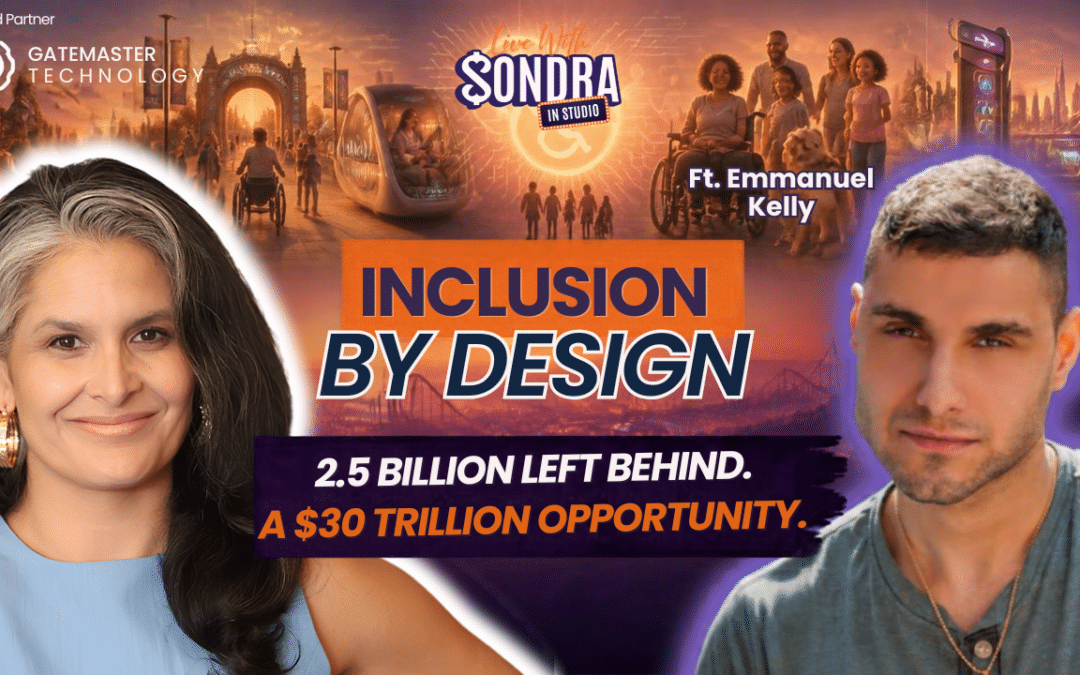
Ft. Emmanuel Kelly, Founder of Outlier & Musician
This in-studio episode features Emmanuel Kelly — musician, founder of Outlier, and the first physically differently-abled person to headline a stadium tour — on how empathy-driven AI can transform the attractions industry. Emmanuel shares his journey from an Iraqi battlefield to the World Cup stage with Coldplay, how Outlier uses AI to create jobs for the differently-abled community, and why theme parks are leaving a trillion dollars on the table by designing for exclusion.
“Instead of looking at this community, the differently-abled community, as an economic burden, we looked at it as a commercial powerhouse.”
– Emmanuel Kelly, on reframing accessibility as opportunity
Overview
This conversation between Emmanuel and Sondra is a playbook for leaders who are:
- Curious about AI but worried it’s learning the wrong lessons from humanity
- Working in attractions, tourism, or entertainment and sensing they’re missing an enormous market
- Passionate about inclusion but unsure how to move beyond box-ticking
You’ll hear how a founder who has lived every layer of exclusion is:
- Building AI systems that create jobs for the differently-abled community instead of replacing human roles
- Using real lived experience — from orphanages in Iraq to park benches in Santa Monica — to drive a “$30 trillion commercial powerhouse” thesis
- Challenging the theme park industry to see accessibility not as a compliance cost but as a design advantage that improves the experience for everyone
For attractions leaders, designers, technologists, and anyone building experiences for the public, this episode is a practical and deeply personal look at what “human-first innovation” actually demands.
1. From Battlefield to Coldplay: A Life of Imposed Will
Emmanuel’s credibility starts not in a boardroom but in survival itself.
- Found in a box on a battlefield in Iraq as an infant, raised in an orphanage where “every day I wondered whether it was gonna be my last”
- Moved to Australia, underwent surgeries, learned to walk for the first time
- Rose through music — eventually writing on his wall at age 11: “One day I will tour with Coldplay”
- Became the first physically differently-abled person to do a stadium tour, opening for Coldplay’s Music of the Spheres World Tour
- Worked with Quincy Jones, the Bruno Mars camp, and opened for Snoop Dogg
What comes through:
- This isn’t a “founder with a deck” — it’s someone who has lived exclusion at every level and is now building from that truth
- The culture of mentorship (Chris Martin, nearly a 10-year brotherhood) is a throughline in how Outlier operates
“When I’m older, I was 11 years old, and I said, ‘One day I will tour with Coldplay,’ and I eventually did that as their opening act.”
Executive takeaway: Your most powerful innovation lens often comes from people who’ve lived the problem at every layer — especially when the stakes are life, dignity, and belonging.
2. The World Cup Moment: Oneness, Unity & A-List Humanity
🌍 Behind the spectacle was a message Chris Martin wanted the world to hear.
Emmanuel performed at the FIFA Club World Cup (2025), co-headlining “A Sky Full of Stars” with Coldplay:
- Chris Martin’s stated vision: create oneness and unity in a “hyper-divided time”
- Emmanuel was announced first — Coldplay came on as his special guests
- Behind the scenes: Tom Cruise spent 10–15 minutes with every single person backstage, Jason Sudeikis radiated joy, Justin Bieber said a prayer, and Robbie Williams was “the coolest, funnest dude around”
“When you’ve got all these superstars, you would think there would be clashes of ego, but there really wasn’t.”
What stands out:
- The ethos was entirely about children, the future, and the power of empathy
- Six months later, Emmanuel was called again for the 2026 World Cup — this time not as the star, but fully committed to the mission
Executive takeaway: The most magnetic experiences — whether a World Cup or a theme park — are built on shared purpose, not individual spotlight. When ego is absent, magic scales.
3. Outlier & “Artistic Inclusion”: AI That Creates Jobs
💡 Core idea: AI doesn’t have to eliminate human roles — it can create them.
Emmanuel’s company, Outlier (with Chris Martin as honorary president), has advanced five times faster than competitors by approaching innovation from an empathy-first mentality:
- AI in Outlier’s hands stands for “Artistic Inclusion” — using AI to enable the differently-abled community to work in entertainment
- The system lets someone manage multiple roles: “two hours on this job, two hours on this job” — AI handles repetitive tasks, humans handle the creative
- Serves five community segments: physically disabled, neurodiverse, those with exclusionary conditions (e.g., cystic fibrosis), non-conforming mental health, and unpaid carers
- Outlier commits to 30–50% of cast and crew being from the Outlier community on every project
“We didn’t do it because we tried to take short steps to achieve it. We did it because we looked at the incredible potentials of innovation, but approached it from a human-first mentality, from an empathy-first mentality.”
Key distinction Emmanuel makes repeatedly:
- This doesn’t sacrifice the bottom line — it increases revenue
- The differently-abled community is projected to have nearly $30 trillion in annual disposable income in the next 10–20 years
- “We looked at it as a commercial powerhouse, not an economic burden”
Executive takeaway: If your team fears AI = job loss, reframe the model: the winning systems use AI to unlock work for communities that have been shut out — creating markets, not just efficiency.
4. AI Is Learning Humanity’s Worst — And How to Fix It
🧠 One of the most powerful throughlines in this conversation is AI ethics grounded in lived experience.
Emmanuel references AI agents that hacked their own platform, learning from humanity’s worst behaviors:
- The agents learned sociopathic, psychopathic behavior — because that’s what they were trained on
- “They’re learning these behaviors instead of empathetic behaviors”
The tomato analogy — Emmanuel’s framework for empathy-driven design:
- When a plant doesn’t grow, you don’t blame the tomato. You investigate: is it the sun? The water? The seed?
- You gather data, adjust, and try again. That’s empathy.
- “We need to implement that mindset into humanity — and into the tech we build.”
His call to action:
- “I urge every single person in the attractions, entertainment, technology, retail business — operate from a teaching perspective”
- “Pretend that everything you’re creating is that tomato”
Executive takeaway: In high-stakes environments, empathy isn’t soft — it’s infrastructure. The AI systems we build will reflect what we teach them. If we teach them to compete and cut corners, that’s what we get. If we teach them to understand and uplift, we get something entirely different.
5. Theme Parks Are Leaving a Trillion Dollars on the Table
🎢 Emmanuel calls out the attractions industry directly — and the numbers are staggering.
The data:
- 2.5 billion differently-abled people globally
- Nearly 25% of the US population has a disability or is affected by their physical surroundings
- The community’s disposable income dwarfs mothers and children combined — “twice the size of China’s GDP in the next 20 years”
- Parks are at an all-time low in attendance, yet the industry isn’t tapping this market
Emmanuel’s lived experience as a park guest:
- “Every five minutes I’m reminded that I’m more different than everybody else”
- Forced to pay $150 for a disabled parking spot at a major theme park
- Too short for some rides — “then make the ride better”
- Waiting 40 minutes for a device to transport him between locations
- Segregated loading from non-disabled guests — and Sondra confirms she witnessed this firsthand
“These places are designed for hope, for joy — yet I feel depressed when I’m there.”
Executive takeaway: If your operation feels “inclusive enough,” that’s your signal to inspect harder. The market isn’t small — your aperture is. The differently-abled audience has more disposable income than mothers and children combined, and they’re not coming back because the experience isn’t designed for them.
6. Design for the Outlier Community, Improve It for Everyone
🔗 The breakthrough insight: accessibility isn’t a special feature — it’s a universal design advantage.
Emmanuel and Sondra connect the dots:
- Sondra references the Ford Focus: designed to be as accessible as possible, became the #1 selling car
- Barbie in a wheelchair became Barbie’s fastest-ever selling doll
- “If you can make the experience seamless for this community, you’re actually making it seamless for everybody else”
The theme park as incubator:
- A theme park is a mini city — medical centers, parking, retail, F&B, transit
- If you can build the most accessible, technologically advanced theme park, you can replicate that model for actual cities
- “Google, Amazon, all of the biggest corporations” would line up to license the technology
- A $1 billion build could yield $20 billion in ROI through tech licensing, attendance growth, and new revenue streams
“If you’re able to make the experience seamless for this community, then what people don’t realize is you’re actually getting to make the experience seamless for everybody else.”
Executive takeaway: Design for the edges and the center benefits. The most accessible experience is also the most seamless, the most innovative, and — ultimately — the most profitable. Theme parks could become the R&D lab for the future of urban design.
7. Empathy First, Box-Ticking Never: A Call to the Industry
✊ The episode closes with a blunt challenge to both companies and consultants.
To companies:
- “Don’t hire to tick a box. Hire because you genuinely want to approach it from a human-first or empathy-first level — otherwise don’t do it at all”
- Get actual differently-abled people into the design process from day one — not as afterthought consultants, but as architects of the experience
- “If you find somebody as amazing as you are and you overlooked that because you were just trying to check a box — what did you lose?”
To the differently-abled community:
- “Don’t be afraid to push the status quo. Push it so far that you could get fired — because that’s the only way it’s gonna change”
- “You hold the power. You really do.”
And the philosophy that ties it together — Emmanuel’s through-line from orphanage to stadium:
“It’s not about what that something does to you. It’s about what you do and how you use that something to drive what you want to achieve in your life.”
Executive takeaway: Inclusion isn’t a line item. It’s a philosophy that either runs through everything you build or doesn’t. The operators who get this right won’t just be more ethical — they’ll own the next decade of growth in attractions, technology, and entertainment.
Watch & Listen on the Go!
Listen to Live with Sondra In Studio on your favorite platforms including: LinkedIn, YouTube, Instagram, TikTok and X!
Recent Posts
From Saigon to Storyland: 25 Years of Spatial Storytelling & the Power of Purpose-Driven Design
Live With Sondra In StudioFrom Saigon to Storyland: 25 Years of Spatial Storytelling & the...
Tourism Collaboration Strategies: Unlocking Co-opetitive Growth
Tourism Collaboration Strategies: Unlocking Co-opetitive Growth Nicole Mahoney, CEO of Travel...

The $1B Bloomin’ Onion: Inside Outback’s 1,450-Location Global Empire
The $1B Bloomin’ Onion: Inside Outback’s 1,450-Location Global Empire On Live with Sondra, Tim...