Live With Sondra In Studio
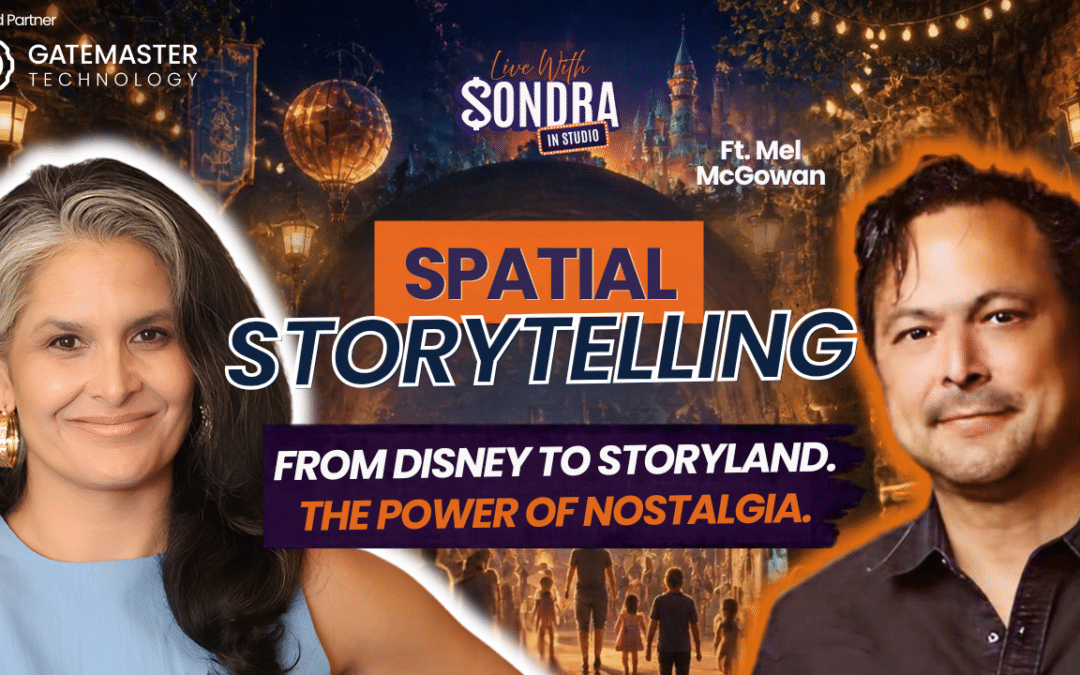
From Saigon to Storyland: 25 Years of Spatial Storytelling & the Power of Purpose-Driven Design
Ft. Mel McGowan, Co-Founder & Chief Creative Officer of Storyland
This in-studio episode features Mel McGowan — co-founder and Chief Creative Officer of Storyland, a spatial storytelling and experience design firm celebrating its 25th anniversary — on how purpose-driven design, deep industry history, and the fusion of past and future can transform the attractions world. Mel shares his journey from childhood memories of bombs in Vietnam and lights at Disneyland, to a decade at Disney, to building a 100+ person global practice with his brother. Along the way, he recounts designing a healing village for survivors of child sex trafficking, explains why nostalgia is a magnetic force in uncertain times, and breaks down his “three S’s” formula for making any experience happen.
“Our paraphrase is doing significant work, telling stories that lift the spirit with people I love and trust.”
– Mel McGowan, on what drives Storyland after 25 years
Overview
This conversation is for leaders who are passionate about storytelling, curious about the history of the attractions industry, and looking for a practical framework to make experiences actually happen. You’ll hear how a founder whose earliest memories fuse war-torn Vietnam with the lights of Disneyland is building a global practice in “three-dimensional storytelling,” using design as a force for transformation, and challenging the industry to stop ripping out its history and start celebrating the nostalgia that lives in its guests.
1. From Saigon to Disneyland: The Wiring of a Storyteller
Born in Saigon to a GI father and Vietnamese mother, Mel’s earliest memories are bombs in Vietnam — and the lights of Disneyland, where his father did a stint when they returned to the States. After moving back to Germany, he carried “weird wiring memories” of a broken world and a world that could and should be. As a teenager, he wrote letters to what’s now Walt Disney Imagineering with free attraction ideas — and got a “cease and desist, stay in school” form letter back. He was drafting theme park master plans on his bedroom table before SimCity existed, detoured briefly into post-punk music, then went to work for Disney, who paid his way through grad school.
“I just have these weird wiring memories as a kid growing up of this kind of broken world, right? And this kind of world that could and should be, and I think that kind of fused together to create some unique wiring.”
Executive takeaway: Your most powerful creative lens often comes from the intersection of contrasting early experiences. When someone has lived between worlds — war and wonder, brokenness and beauty — they see possibilities others miss.
2. Storyland at 25: Building Outside the Berm
Mel was set at Disney — taken care of, grad school paid for, an amazing run. His brother Peter, who’d done well in the tech boom and was ready to retire at 30, challenged him to think about “transitioning from success to significance.” They joined forces like “Avengers assembling” — Peter brought interactive and digital storytelling; Mel brought “boring old bricks and mortar” (what Disney calls imagineering, Storyland calls spatial storytelling). Founded just after 9/11, they’ve grown to 100+ team members worldwide, survived COVID without layoffs, and operate with lifelong friends as COO and CFO. Only recently did they move from a 20-year “well-kept secret” behind NDAs to a more proactive, visible practice.
“We just thought there might be an itch to scratch and a need in the ‘real world,’ outside the berm, outside the pearly gates of Disney, to bring a little bit more order out of disorder and intentionality into a chaotic, broken world.”
Executive takeaway: The most sustainable creative businesses are built on trust — between partners, between disciplines, and between vision and operations. When you assemble the right people with a shared purpose, resilience becomes structural.
3. The Village of Hope: When Design Becomes Transformation
Mel’s most meaningful project came through family — a cousin’s wife who discovered child sex trafficking and flew to the Philippines to open a shelter. Storyland partnered to design a village for survivors, funded by clients and partners. Mel’s team secured an ocean bluff-top site with 270-degree views, placing perimeter fencing at the base so the girls never see the walls. Instead of dormitories, they designed open-air casitas — six girls and a house mom — around a healing garden with harvested moringa trees and a pavilion for continued education. The result feels like Kona Village in Hawaii — “a taste of heaven on Earth.” Survivors are now finishing school and aspiring to careers in design and architecture.
“In a single seed, you have the potential of an entire tree. But then in the potential of a tree is the potential of an entire forest.”
Executive takeaway: The skills you’ve built in one domain can create transformation in another. When you apply experience design to human restoration, the impact ripples outward — from one life to an entire forest of changed lives.
4. The History and Power of Story in Attractions
Mel traces the industry’s lineage from European pleasure gardens to Luna Park — not unsophisticated “carnie” stuff but a fully realized moonscape with a million incandescent lights that “burned a hole in people’s brains.” Walt Disney didn’t create from nothing — he benchmarked Tivoli Gardens, Knott’s Berry Farm, and trolley parks, then synthesized them. Disney’s fusion of past and future — state-of-the-art technology applied to idealized nostalgia — is “one plus one equal three.” But for years, working with park chains was “pushing a rock up a hill” because operators prioritized new rides over celebrating their own history. Mel and Sondra bond over personal park memories — Sondra’s grandfather starting every Disneyland visit at the Tiki Room, Mel’s adopted brother being called “Kenjiro” for 40 years because E.T. butchered his name — proof that attractions create the most durable, identity-shaping memories people carry for life.
“Even working with chains, it was felt like pushing a rock up a hill because for a while it was always about the bright paint job or the sexy new ride… I’m like, ‘You guys are just missing the boat.'”
Executive takeaway: Your park’s history isn’t a liability — it’s your most authentic competitive advantage. Guests aren’t just riding rides; they’re building family mythology. The operators who celebrate that will tap an emotional reservoir their competitors can’t replicate.
5. The Three S’s and What’s Next: Soil, Silver, Story
Mel’s framework for whether an experience can actually happen:
- Soil: The site or facility — without the right ground, nothing grows
- Story: The IP — the story is what gets people out of their houses
- Silver: The seed capital — enough to instigate soft costs and get the concept in front of investors
- “It’s not gonna happen unless you have all three of these things converging.”
What’s new at Storyland: Ozone, a new software platform Mel calls a “game changer” — like the Unreal Engine but for character animation. Storyland Development & Locations, moving from waiting for the phone to ring to proactively creating experiences from the ground up. And emerging markets in the UAE and beyond.
Executive takeaway: Vision without soil, silver, or story is just eye wash. The winning formula requires all three converging — and partners who can bring the missing ingredients to the table.
6. The Orchestra Pit: Why Every Role Matters
The industry is a collective art form — “so many instruments and so many seats, and that conductor is trying to envision how it all comes together.” Sondra highlights how ticketing and software are the first actual touch most guests have with an experience. Mel recounts being stuck as the “navigator guy” at Universal Studios Osaka, missing the entire arrival sequence because he was glued to the app — and a worse experience at the Osaka World Expo where software “butchered” the guest journey. Both veterans still go to parks and feel the magic — Mel was caught sneaking off from an educational tour to ride Atlantis’s “Not So Lazy River,” and Sondra treasures her Tiki Room tradition.
“You can have a built wonderland, but if you can’t figure out a way to let people get where they need to get, then yeah.”
Executive takeaway: No single discipline makes an experience great. From the architect to the software engineer to the person sweeping the steps — every role is part of the orchestra. The experiences that endure are the ones where every instrument was heard.
Watch & Listen on the Go!
Listen to Live with Sondra In Studio on your favorite platforms including: LinkedIn, YouTube, Instagram, TikTok and X!
Episode Transcript
The Most Memorable Project
0:04
What would be like the most memorable or favorite project that you’ve had to work on? Oh boy. You know, we used to hate that
0:09
question, right? Cuz [music] it’s kind of like someone asking you, “Okay, well, which of your kids do you like? Which which one’s your favorite kid?”
0:15
Right. Just kind of hear from you a little bit [music] about how you feel that maybe
0:21
the industry is changing a little bit with regards to storytelling and where we came from cuz I know like you’re very knowledgeable about this. Well, you can
0:29
call it knowledgeable or you call it being a nerd, but yeah, I [laughter] mean, I do think that there’s value in in paying attention to history and yeah,
0:35
all the brain damage that those that went before us kind of incurred. That’s what I love about our industry, right,
0:41
is that it’s this collective art form. Yeah. That uh you know, requires the skills of
0:46
so many people in those uh orchestra in that orchestra pit. You got so many instruments and so many seats and that
0:53
that conductor or that composer is trying to envision how it all comes together. Uh, but we we’re in it because
0:58
we love it, right? Rather do this than, you know, I I 100% agree. Well, Mel, welcome to
Introduction: Meet Mel McGowan
1:04
Live with Sandre. Yeah. Thanks for the invite. Appreciate it. Appreciate you being here. We’re here in
1:09
Los Angeles. Get to be here and we’re La La Land hometown. [laughter] My adopted hometown at least.
1:15
Yeah. Well, you know, before we get started, I would love to know because one of the things that I’ve enjoyed
1:22
about conversations with you are one how knowledgeable you are of what’s
1:28
happening in the industry, but also, you know, where we’ve come. Um, but I want
1:34
to know where you’ve come from and kind of where you got your start in the industry and how that happened.
1:39
Well, that’s that’s boring, but well, I was born in Saigon. Um, earliest memories are bombs going off in Vietnam.
Born in Saigon: Mel’s Origin Story
1:45
Uh, and then also looking down the lights at Disneyland. So the the way that worked is my dad was a GI, my mom’s
1:52
Vietnamese. Um, so, uh, born there, grew up in Europe and Germany, but, uh, when we came back to the States, uh, my dad
2:00
did a stint at Disneyland, um, and, uh, you know, was able to get us into the park. And so, again, pretty formative.
2:06
Three and a half years old maybe, just looking down the lights at Yeah. at Main Street USA. And then we moved
2:12
back to Germany. So, I just had these weird wiring memories as a kid growing up of uh this kind of broken world,
2:19
right, [laughter] and this kind of world that could and should be. And I think that kind of fused together to create
2:24
some unique wiring. Uh but then I, you know, I remember being a teenager and, you know, being able to visit Disney,
2:31
uh, with enough of a sense of reality to understand what’s going on and to be curious about how did they throw me out
2:38
that window at the Darling House and how did I fly over London and not die, you know, and and um and so I remember
2:44
specifically writing my first letter to uh what’s now Walt Disney Imagineering, then it was known as WED, uh, giving
2:50
them all of my free consulting and wisdom of all the things they need to fix, all my free attra action ideas uh
2:57
particularly how to fix Tomorrowland. Uh and uh you know of course getting the the cease and desist stay in school kid
3:04
and [laughter] letter back. But but I mean that was I think the start of me because I was you know um in my room
3:09
drafting table drawing up master plans for theme parks and future cities before there was a Sim City or a Roller Coaster
3:16
Tycoon or whatever you know video games. And um you know really kind of stayed on that path. I kind of felt like I
3:23
detoured a little bit into music and I was really into kind of postpunk. Uh got
3:28
got signed to a label in film school, but uh you know found my way back uh you know quickly uh went right to work for
3:35
Disney uh while I was still in film school actually and they ended up paying my way through grad school and um so
3:41
yeah, it’s been that’s awesome. I think a fairly natural, you know, I love I love the part they had to send
3:46
you an cease and assist. Yeah, I think it’s a pretty standard form letter, you know. That’s so funny.
3:51
[laughter] Well, you know, uh, you mentioned punk music. Yeah. Or post punk. Post punk,
3:57
which I did do my punk phase very briefly, but Okay. Well, yeah. You remember Warp Tour? Uh, I did. I did. Yeah. But see, all
4:04
that’s like, you know, a little after my time. Like I just watched the Control Mo, you know, Joy Division document. I mean, that’s that’s my my era, that late
4:10
70s, 80s, which, you know, I love that. I love that. now morphed into, you know, Cold Play and yeah, all these great, you know, bands that have
4:18
been around the world and back, you know, but, uh, Factory Records, that’s where I would love to go back to. That’s pretty cool. Well, you know, I
4:24
love asking people how they got started in the industry because I feel like so many of us have these stories where we
4:30
started, we knew early on in our lives that we wanted to be here in this
4:35
industry. Yeah. And some of us, I know a lot of people that just fall into it after some people fall into it, too.
4:40
[laughter] And those stories are are always fun to hear from people too because how’d you end up here
4:46
in this industry is uh is always a fascinating question to me. Well, you know, I I want to talk a
Storyland Studios: 25 Years of Spatial Storytelling
4:53
little bit about your company. Yeah. Storyland. Yeah. It’s our uh quarter century anniversary this year. We started uh
5:00
just after 911 2001. So celebrating 25 years. So I can’t believe it’s been a
5:05
quarter century and still still standing and we Yeah, it’s been a it’s been an amazing ride. So, at
From Disney Imagineer to Entrepreneur
5:11
what point did you decide that you’re going to take this from in, you know, creating your own company
5:18
and taking on all the risk that comes with something like that? We talk a lot about the business attractions on this
5:23
show and I’m always fascinated about it. It’s not easy to have a company. I mean, I don’t want my company.
5:29
Yeah. And I’ll be honest, I’m not the serial entrepreneur. Um, I’m I’m blessed to be partners with my brother, my my
5:35
baby brother, Peter McGowan. But I was actually ready to retire at Disney. I mean, I was sad. They took care of me,
5:42
paid my way through grad school, had, um, amazing time there during the my Disney decade of the ‘9s. But, uh, it
5:50
was my brother that really kind of challenged me to kind of say, you know, he was ready to retire at 30. He had done really well in the the whole tech
5:58
boom. And um you know he was he was looking at hey I could either sit on the
6:03
golf course or the beach or whatever but you know would love to do something a little more significant in this next uh
6:08
chapter of life. and um you know and I I’d gone for a decade working like a dog
6:14
and doing grad school and really not spending a lot of time with him or family and you know that opportunity to
6:20
to kind of think about okay transitioning from success to significance and sure
6:26
and intentionality purpose driven kind of design uh it really kind of got us
6:31
thinking about the idea of joining forces kind of Avengers assembling you know he had like a particularly unique
6:38
background in interactive and dig digital storytelling. Um, I was really coming out of what I call boring old
6:44
bricks and mortar. Um, Disney calls it imaginary. We call it spatial storytelling. All the dozens of disciplines that go into experience
6:51
design from architecture, master planning, set design, writing, uh, branding, identity, graphic, you know,
6:57
all that kind of good stuff. And then, um, again, the strategic side is something that I think we both were
7:02
pretty passionate about. the strategery, the the kind of bringing together of what it takes to to execute and pull
7:08
off these these projects. So that kind of magic combination of what we call threedimensional storytelling, we just
7:14
hadn’t seen anyone else doing that. Obviously being in the Disney ecosystem, you got plenty of smart people doing
7:19
that internally, but we just thought that there might be an itch to scratch and a need in the quote real world out
7:25
of the outside the the burm outside the pearly gates of Disney uh to to to you know bring a little bit more order out
7:32
of disorder and intentionality into kind of a chaotic broken world. And and uh so
7:38
fortunately I was really conserved. I thought, man, I don’t know. This is really kind of risky, you know, um and
7:44
he was a little bit more, you know, gung-ho about it. And, you know, we we sit at over 100 um team members around
7:50
the world and and we’ve been able to avoid a lot of the big waves of hiring and firing and all that craziness from
7:58
uh you know, if if we started out of 911, I think that was a pretty good little trial by fire [laughter]
8:03
to build in some resilience. So we’ve been able to kind of uh you know not have to even co we were able to keep you
8:10
know keep trucking um with the the work we were doing at that time on Sofi Stadium was considered essential
8:15
infrastructure by our governor here in California. And so uh yeah we were able to keep operating. We transitioned from
8:22
everyone being on top of each other in one Southern California studio to really going global and uh creating more of a
8:28
work from anywhere model and and having a stronger international practice. So that’s been, you know, an an evolution.
8:35
But yeah, it’s it’s amazing. I love how businesses evolve like that. Yeah. And and I also work with my sister. I
8:41
don’t know. Wow. I did not know that. That’s amazing. We got to talk war stories, man. My sister and I are partners. And you
8:46
know, it’s funny. I’m not going to believe you till I see some scars. [laughter] Maybe that’s brothers, but
8:53
it’s my it’s my baby sister, so there’s two in between. So we get along really well. But what I um what what what I
8:59
find interesting about what you just told me is so my sister I’m the one that’s always like
9:04
let’s do this crazy thing that she can’t wrap her head around but I’m very lucky to have
9:11
somebody who um in my corner that’s operationally savvy and can kind of help me make that work.
9:17
I don’t know. So would you say that your brother’s the visionary? Are you the visionary? Who we we share the visionary role different
9:23
aspects. Um, we actually have uh again uh one of my best friends since high
9:28
school. We were each other’s best man. He’s our chief operations officer. So again, someone to sweat the detail.
9:33
Another executive that was at Disney finance. Disney paid his way through UCLA’s NBA prayer. He’s our CFO. So just
9:40
lifelong uh brothers, friends, partners that we’ve been, you know, on this journey
9:45
together for a while that we were, you know, that lets me focus on kind of what keeps my tank full and grave juices
9:52
flowing. So, I I tend to focus as chief creative officer on kind of what really I want to focus on rather than the the
9:58
stuff that keeps the lights on and keeps us out of jail. I love that. I love [laughter] that. I love that you said it’s your friend. I actually have a
10:04
saying in my business. I want to do cool with cool people. Yeah. Because I’m in a a very similar place to
10:10
you in so much that at this point in my life, I really just want to create
10:16
something with purpose. And it sounds like that’s just from getting our our paraphrase of that is doing
10:22
significant work, you know, telling stories that lift the spirit with people they love and trust. Yeah, I love that.
10:28
Both on the internal and the external the client side. So, it’s it’s fun. I love that. And then I know that you share probably a similar belief that
10:34
what we’re doing in creating these experiences, I know we’re in different scopes of the
10:40
of the industry for sure. I mean, I’m on the technology side and the software and it’s maybe not as glamorous, but it’s on
10:47
the, you know, we we always say our job is to make sure every attraction is massively successful. Absolutely. Yeah. and and and and
10:54
focused on the revenue. But even still, I feel like this industry is so important to people and humans and being
11:01
able to create experiences that give people an opportunity to be with loved
11:06
ones and to have memories that they look back on, they look forward to.
11:12
Absolutely. Yeah. I mean especially in today’s what I call digitally divided uh
11:18
days you know of like algorithms pushing us you know into increased addiction to
11:23
screens to these scary dark corners of fear and insecurity and even hatred. Uh
11:30
I think the the the need is so much greater than ever you know to to do you
11:35
know we’ve of course focused on the power of story to get people kind of uh
11:40
you know out of their house uh when when you can create kind of these epic storytelling uh experiences that
11:46
transform I mean it’s just there’s power there there always has been power in
11:51
story to form us and that transform you know who can you know there’s power that could be used for positive or negative
11:58
but obviously we’re uh we’re hoping, believe in and we surround ourselves with clients and collaborators that you
12:03
know use that as a force for good. So yeah, for sure and I think like the
12:09
general public you know needs these opportunities to get away to have this reprieve from all of the things the
12:14
digital Absolutely. I mean I’ve got eight kids and uh you know to to me as a dad of eight you know what the the amount of
12:21
work it is to pull eyeballs off of a screen and to to create some core
12:26
memories together. I mean, I think uh a lot of people can the parents can feel this. You know, we’re willing to put a
12:33
lot of time, effort, and dollars into those things that help us with that that mission of, man, I I want to I want to
12:40
be intentional about kind of creating and and creating opportunity for some of those core memories with with my kids.
12:45
And that’s totally just selfish me as a dad to my daughters and my my kids. Um but, uh you know, again, there’s a the
12:52
whole world out there that really needs that is craving for that connection. Yeah, agreed. And I, as a parent, I feel
12:58
the same way. You know, some of the best memories I have with my kids are I have this favorite memory I can share with
13:04
you. My we my kids I don’t even think they were they might have been like four and six, my oldest two and we had gone
13:11
to Disneyland and my husband and my youngest were sick. So they were just in the hotel room. That’s special though. A little
13:16
one-on-one time. Yeah. So I got to be alone with these two kids who were maybe four and six. That’s magical. And they were just, you
13:23
know, they didn’t they didn’t, you know, at that age, you don’t have a lot of stamina for anything. But these two just we closed the park
13:29
down, the three of us. And it was it’s still one of my favorite. It’s funny that you said that’s my favorite Disney day ever. And I do
13:36
Disney Live. Anyone that knows me knows that I use it as my office basically. But um my youngest son uh was uh in a
13:43
special needs orphanage in China. and I had the foresight to spend the last day uh in China um at at Hong Kong
13:51
Disneyland. Shanghai hadn’t even opened yet, but we’re flying out of uh Lantau airport. And so I I thought, man, I want
13:57
to tire this kid out for [laughter] him and his sister also adopted from China. You know, we I I just spent the
14:03
day trying to catch up with him. But he had gone from this institutional setting to running around Tarzan’s treehouse
14:09
and, you know, driving Autotopia car. And I mean that was by far, you know, I mean it was opening day Hong Kong
14:15
Disney. I mean opening year was pretty pretty new. Not the biggest ride count, but none of that mattered. It was the
14:21
closest I’ve been to. Also time travel uh back to the feeling of being at Disneyland in 1955 around the opening in
14:27
terms of the size and the the feel and the intimacy and the charm. I thought, you know, they really pulled that off
14:33
there. Yeah. because we were just in Hong Kong with Ayapa, right? Asia and
14:38
I didn’t think about that while I was at Disney. Yeah. Um but I totally can see what you’re
14:45
saying now with regards to that even though it’s grown quite a lot. But it’s grown into one of my favorite castle parks. It’s a I think it’s a
14:51
great park. I mean, it just feels feels right. Yeah. That’s awesome. Well, so I’m I’m curious because I know you’ve worked on
14:58
so many projects around the world now that you have a few [laughter] and you know uh and and and and maybe
15:05
it’s an old project, maybe it’s a new project, but you know what are what would be like the most memorable or
15:10
favorite project that you’ve had to work on? Oh boy. You know, we used to hate that question, right? Because it’s kind of
15:15
like someone asking you, okay, well, which of your kids do you like? Which which one’s your favorite kid? Right. [laughter]
15:20
Um and I I think I can definitively say so. Uh there was one that uh came across
15:26
through a family member, my cousin, um and uh his wife had just found out about
15:32
this issue uh of child sex trafficking and she basically found out about it,
Designing Hope: A Village for Survivors
15:38
hopped on a plane, went to Philippines and was involved with opening up a kind
15:44
of a shelter um called My Refuge House. And we ended up partnering um and and
15:50
helping create this organization, this nonprofit. and um ended up essentially designing helping get funded through
15:57
clients and partners of ours and then I end up joining the board uh for this u
16:04
village of hope, this village for survivors of child sex trafficking. Um and again different clients of ours
16:10
funded individual because I mean some of the challenges with that is you know we had an amazing uh project director an
16:17
owner’s repe director to to move away from one of the world’s leading nonprofits um uh to to
16:26
lead up this project and she was our toughest client because she’s like well I need you know uh I think it was 30
16:33
foot high perimeter walls I need armed security I need, you know, all these requirements. And I I was like
16:40
scratching my head. I’m like, well, we don’t really do jails or juvies, like this isn’t like, [laughter] you know,
16:45
it’s like we need to protect the the girls from organized crime folks. They need psychological detox. I mean, all
16:51
these kind of things that really started sounding a lot more like a detention facility. You know, it was just really
16:56
crazy. And but we ended up getting this ocean bluff top site with 270°ree ocean
17:02
views. We were able to put all the perimeter fencing at the base of that. So the girls are we designed and rather
17:07
than dorm style lodges we we did these uh cassitas that are um you know three
17:12
bunk beds um you know six girls and a house mom you know kind of open air easy
17:18
breezy cassita style around this kind of uh open healing garden that we harvested
17:23
mango trees and an ohana pavilion where the girls could continue education uh and it really was it feels like I don’t
17:30
know Kona village in Hawaii I mean it’s like a place that I would vacation I mean I would live there in Harvey. It’s
17:35
beautiful. And so it was more of a taste of heaven on earth, you know, and rather than kind of the hell on earth that some
17:42
of these girls were, you know, being rescued from. So just an amazing journey. And again, the life transformation stories that we hear out
17:48
of that, uh, including um, girls that are, you know, aspiring now, they’ve
17:53
finished school, wanting to be a designer, wanting to be an architect. It’s really kind of some powerful stuff. That’s pretty cool. That’s really cool
17:59
story. And it’s really one of many, many cool stories you collect along the journey. Well, and I’m
18:04
sure like you mentioned early on like the purpose, you know, being purpose driven in your in your your business, in
18:10
your organization. And then, you know, it I love that that’s likely something that
18:16
also allows you to do these kind of things that have like an even bigger impact on the world. I mean, that’s big
18:22
impact right there. Well, you know, it’s all starts with an individual and an individual story because, right, you know, out of a a
18:29
pebble, you know, you get these ripples, right? I’ve I’ve always loved the analogy that you know in a the in a
18:35
single seed you know you have the potential of an entire tree including some of the living the largest living
18:40
organisms on the planet right whether it’s sequoia trees or whatever but then in the potential of a tree is the
18:46
potential of an entire forest and so yes just that idea of the the potential of an individual life transformed is really
18:52
compelling and starts with our own lives right for myself for my team my family my brothers um you know you only have
18:59
kind of a you know I think of it as a vapor, you know, on the side [laughter] Yeah. of of the dirt of eternity. And so to to
19:07
try to use that, you know, wisely. And you could either use that selfishly or you could try to have some significance
19:13
and and be a little less selfish about it, you know, which, you know, nobody’s the same, but you know, I love that.
19:19
I mean, I’ve never had that kind of impact on the world. I hope to. I’ I’ve worked in animals. You never That’s the thing. You never
19:25
know. You never know. I did animal rescue for years. Yeah. uh fundraising but then also helping with
19:32
adoptions and and so I can feel that like yeah my daughter has that but she’s fostered probably 30 well no easily way
19:38
more than that but uh yeah 30 same I remember when I was in my early 20s I think I had like
19:45
I don’t want to admit how many animals yeah we had to set up basically a facility for in [laughter] our Yeah it’s
19:50
crazy you know but still involved in that cause and and and it truly was the business that’s allowed me to continue
19:57
to have a much bigger impact than just a bunch of animals in a apartment in LA, right? But [laughter]
20:03
we we’ve done all those animals. That’s great. Yeah. My landlords used to be like, “She’s doing her thing again.” I
20:09
remember one time I This is just a funny story, but one time we were at the LA shelter, the South LA shelter, and it
20:16
was Easter, right? So, had a bunch of bunnies, and I didn’t know what I was going to do
20:22
with these bunnies. And I took home like 11 bunnies that were all in my apartment. I don’t know my word. That’s
20:28
I had and and actually had one for 10 years. They kept one for 10 years. Okay. She was the meanest one.
20:35
I’m pretty sure she was just a a wild bunny that they caught in [laughter] a fish shelter.
20:40
But yeah, doing doing things like I I really do believe though the work that we do allows us to follow our passions
20:48
and and do more in the world. And and then I love how you also bring it back to storytelling.
20:54
And I want to just kind of hear from you a little bit about how you feel that
How Storytelling Is Changing the Industry
21:01
maybe the industry is changing a little bit with regards to storytelling and where we came from because I know like you’re very knowledgeable about this.
21:07
Well, you can call it knowledgeable or you call it being a nerd, but yeah, I mean, I do think that there’s value in
21:12
in paying attention to history and yeah, all the brain damage that those that went before us kind of incurred along
21:19
the path. So, I’ve always been fascinated with the roots of the industry from the European pleasure gardens uh to you know the world’s fairs
From Luna Park to Disney: The Roots of the Industry
21:27
and um and you know the kind of the original founding of like the American industry in terms of Coney Island and
21:34
Luna Park and and a lot of times people look back and they think oh that was just so unsophisticated. It was just
21:39
carnese or Iron Rides and it really was not the case. When you talk about Luna Park, I mean, talk about storytelling.
21:44
They were literally creating this moonscape, this fantasy vision that was supposed to be
21:50
the city on the moon, uh, that was, you know, inspired by exotic architecture from around the world, mostly the Middle
21:57
East and Asia. Um, and it really was this, you know, the first time that all these immigrants uh had seen electric
22:03
light. So, to to have a million incandescent lights burning, you know, on the Atlantic Ocean, you know, just
22:10
burned a hole in people’s brains. and and even that concept was kind of replicated around the world. I mean,
22:16
I’ve seen it replicated in Sydney and Melbourne, some of the still standing, they still call it Luna Park. Um, and
22:22
again, you know, even going to Tokyo, Disney is considered the most beautiful Disney park in the planet. They’ve got their own homage to to Luna Park at
22:29
their Toy Story uh kind of uh mania, you know, attraction there. Um, and it’s
22:35
just the there’s continuity there. You can’t just kind of simplify and say, “Oh, yeah, it was all just crap.” And
22:40
then Walt Disney came along and, you know, created something out of nothing. Cuz he was really, uh, curious enough
22:46
to, you know, uh, benchmark starting as a little kid, seeing his local trolley
22:51
park, you know, again, the lights of that little trolley part as he’s looking through the fence, uh, you know, burn a
22:56
hole in his brain and thinking, man, that’s a that’s a taste of, you know, of
23:01
a heaven or a future that I want to be part of. Uh and then to you know go around the country around the world from
23:07
Tibi Gardens to Knottberry Farm to the Chicago Railroad and to synthesize all these different streams together is
23:14
really kind of fascinating. So even today as we’re um you know doing a new park ground up in the United States and
23:20
what most people you know would rightfully call a mature market here in the US um you know outside of New Gates
23:26
in Orlando or whatever we’re doing a new park ground up in in Nashville. Uh and
23:33
you know, but we’re trying to be cognizant of again what uh you know, the heavy lifting that was done uh the the
23:39
kind of collective trauma of an entire metro era, generations of Nashvilleians that lost a beloved uh park, in this
23:46
case, Opryland USA, the the original show park. Um and you know, where Nate got his start in his career, uh sweeping the
23:54
streets in front of the grand old sweeping the steps in front of the Grand Old Opry. Um, so yeah, just, you know,
23:59
we’re just loving getting into the history of kind of those postw World War II kind of regional parks that were many
24:05
of which were designed by a mentor of mine, a guy named Ira West, who’s an architect with Randall Duel, an old MGM
24:11
art director. Um, and again, you wouldn’t recognize most of these parks. We’ve done work for some of these uh uh
24:17
chains that that steward and own some of these parks. We’ve actually brought out some of those original renders and art pieces that
24:24
were done uh pre-opening. And you know the operators of the existing parks like that’s beautiful. Where is that? I’m
24:30
like that’s your park. That was [laughter] that was the artwork that was done before you opened you know and before all the layers of facilities
24:37
managers just decided to paint a new to pick a new paint palette every season. Yeah. I love that. That’s so cool. Well and I
24:44
do love that we’re going back to so much of the history of the industry. you know, we’re seeing more and more of that
24:50
being maybe brought back into Well, there’s a there’s a draw there’s a power of I mean, nostalgia plays a huge
The Power of Nostalgia in Attraction Design
24:57
role, especially in times where people feel uncertain, unsettled, right? There’s a there’s a a magnetic pull
25:03
towards even if it’s a not always accurate to some idealized rosecoled
25:09
lenses, but I think again one of those things I learned from Walt Disney was that fusion of past and future. you
25:14
know, when you can apply, you know, state-of-the-art technology, in his case, space age, you know, technology to
25:20
like these idealized visions of collective nostalgia, whether it’s interpreted through, you know, your
25:26
memories or through media, you know, in films or IPs, uh, it really is a powerful combo when you can kind of uh
25:33
have 1 plus 1 equal three. Yeah. No. And and when you talk about nostalgia, you know, when I go to
25:39
Disneyland, because that was the park I grew up going to and and and that’s one of the reasons I knew I wanted to be in the industry,
25:45
too, growing up. My mom was a tour guide for exchange students. Wow. Yeah. That’s great. So, her boss used to let her bring my
25:50
sisters and I And I remember just loving every minute of it, having that time with her.
25:56
Um and before my grandfather passed away, you know, he would take us to Disneyland. We would always start at the
26:01
Tiki Room. My mom’s favorite attraction. Yeah, you gota make me tear up. Yeah, I mean he loved it so much. I have an
26:08
aunt named Susette after one of the birds. Pretty deep. Yeah. Yeah. You named one of my ants after
26:15
there. But even with Ayappa when I’ve gone to Disney with I think we were there in
26:20
North America summit a couple years back. I I I begged the you know my colleagues
26:26
that were with me like please can we just start at the tiki room? I just can’t be here and not having experience.
26:32
But it’s just to your point like what how people are interpreting these experiences, how deeply those memories
26:38
go for us. Yeah. And and the crew that I was with was nice enough to give me that which was
26:44
Oh, that’s that’s good. I know we had to promise Dwits, but you know, well, you you clearly communicated the significance of it to you. But yeah, I
26:50
mean, you know, again, even working with uh chains, it was it was felt like a rock pushing a rock up a hill. Yeah.
26:56
Because for a while it was always about the bright paint job or the sexy new,
27:01
you know, ride or the roller coaster, whatever. And I’m like, you guys are just missing the boat. Because at this
27:07
point, you’ve got 40, 50, 60 years. I mean, I’m talking even some of the parks that just opened in the 70s. You’ve got
27:14
this wave of folks that would love to celebrate anniversaries, that love the
27:19
old logos, the old even the defunct attractions. Let’s let’s celebrate some of that stuff. And um you know anyways
27:26
it’s it’s just fascinating because that just was not the standard operating procedure for a while unless again
27:31
Disney was one of the only because Universal even was very quick and I think they kind of still are in ripping
27:36
out attractions to bring on the newest latest. I mean, you know, like again, the to take out the Back to the Future
27:43
ride. I mean, that was just awesome, right? I mean, already built into all this great 50s and 80s and stuff, but to
27:49
rip that entire thing out and I like the Simpsons as much as the next guy, but it’s not Back to the Future, you know?
27:54
And so, I wouldn’t be surprised if someone wakes up and realiz
28:00
abs. Well, we we still have that in Florida at least. So, that’s that’s my tiki room of Orlando. [laughter]
28:05
Basically, that’s my holy trinity in Orlando. the the nerd in carousel progress people mover and et [laughter]
28:13
yeah I remember one time I was on the I had this brother wait we my they all have air conditioner that’s a common [laughter] denominator too
28:20
well I remember being a kid my brother uh I have an adopted brother from Japan
28:26
and he he was just learning English at the time and so I remember like ET
28:31
totally butchered his name and we we that became they his name’s Kenji but But ET called him Kiro
28:40
and we have literally called him that. [laughter] I mean the poor guy’s been called that for 40 years now because of that
28:45
experience. But that’s the kind of impact you’re making on people’s minds and their memories and and how they
28:50
interact with family. That’s hilarious. You know that’s a great story. Yeah. He’s going to kill me for saying that in the show. But
28:56
well I’m going to have to meet him and call him Kanger [laughter] now in that creepy ET voice. Gro.
29:02
I love that. I love it. Well so what’s what’s new for you guys? what’s what’s on the horizon? What’s something that you’re really excited
What’s Next: Ozone and the Future of Experience Design
29:09
about? You know, for us, I think um again, integrating some of the new technology
29:14
um you know, when we talk about uh whether it’s AI, we’ve got a new software uh that uh we’re excited about
29:21
called Ozone that is it’s a gamecher for anyone that knows uh animation or video.
29:27
You know, there’s an engine called the Unreal Engine. This is almost like the Unreal Engine for character animation.
29:33
And so just all the technologies converging, the tools at our disposal,
29:38
um the the brands, the IPs that are kind of that we’re the stories that we’re being asked to steward and be entrusted.
29:45
It’s it’s really pretty exciting. I mean, part of our story was, you know, for our first 20 years, we
29:50
were almost um almost prided ourselves on being this kind of well-kept secret, you know, like the the secret weapon of
29:57
our friends [snorts] and colleagues, and we didn’t mind that being behind the NDAs and whatever because I always
30:02
thought, hey, that’s great. We don’t have to spend any money on business development or market, you know, because it’s always about it’s always great to
30:08
just Yeah. Yeah, fill your creative tank with uh patrons, benefactors, partners that you love and
30:14
trust and like I said and but it really um was just fairly recently that uh you
30:20
know one of my partners kind of said okay well you know that whole indie
30:25
postpunk club you know like [laughter] you know that’s that’s okay but you know there
30:31
you kind of like there’s a a greater need uh you know in the world out there for uh what you guys do besides just
30:37
working for you know some of the bigger uh companies and um so that’s been a joy to the diversity that that’s brought
30:43
along in terms of the different types of and even again in emerging markets whether it’s the sands of Arabia uh uh
30:50
UAE uh you know you name it it’s just fun to get involved with some of these new markets and um you know and and in
30:57
some cases they uh you know are different stages of the journey but we we love kind of triangulating
31:03
kind of I think what we we think of as the successful formula for experience development I call it the three S’s,
The Three S’s: Soil, Silver, Story
31:10
soil, silver, and story, right? Uh, and you know, I’m always able to tell, okay,
31:15
it’s not going to happen unless you have all three of these things converging. So, soil is the the the site or a
31:21
facility, whether it’s a dead anchor in a mall, whether it’s, you know, you know, a site that someone owns or
31:26
controls. Uh, the story of course the IP uh and whether you’re working with a globally recognized IP or whether you
31:31
get get the opportunity to curate and cultivate one that’s soil specific and ground up. Uh it it really is the the
31:38
story is pretty important. And then the silver of course is that seed capital to at least not you don’t have to fund the
31:45
whole thing with one check but you need to at least kind of uh be able to to kind of instigate you know the the
31:51
soft cost and the the pre-development and to kind of get enough to where you can put it in front of
31:57
uh investors or you know fellow uh stakeholders that believe in it enough to put some skin in the game. So
32:03
but yeah it’s been fun. So that idea of being not so much waiting for the phone to ring uh by either our you know
32:10
existing clients or partners but really to be a little bit more proactive on the front end has been kind of a a new thing
32:16
for us with Storyline locations and Storyland development. So working with some amazing brands and partners and
32:22
actually you know creating some of these experiences from ground up is really kind of fun. Yeah, that’s cool. That’s really cool.
32:28
Yeah. I can’t I you know I’m I’m on I’m on the very last thing people think about and I’m not saying that that they should
32:34
think about ticketing. No. So important. Yeah. Cuz it’s what it’s like the first actual touch that most people have.
32:41
Yeah. It’s so important. Yeah. But I will say this like I’ve especially doing this show learned so much about
32:48
how these concepts come to me and how the development of parks happen. And it’s
32:55
fascinating to me because sometimes I hear these stories and I wonder if how
33:01
you feel about this like and and hear these stories of of these ideas that people have and where they want to go
33:06
and what they want to create in the world with regards to these experiences and it’s such big vision.
33:12
Yeah. That it’s almost like I I I can’t even wrap my head around that. [laughter] You
33:18
know, how does that work for you? because I’m sure you’re hearing these big visions and sometimes I mean you
33:24
seem to have big vision too. So, well, you know, the funny thing is it’s kind of the kind of industry that, you
33:30
know, you you never want to rain on a visionary, you know, a visionaries parade. And sure, you know, I think back
33:36
to that story of, uh, I think Walt Disney had like Buzz Price, his strategic partner
33:42
go to a predecessor of uh, which is the International Amusement Park Expo
33:48
basically, I think it was in Chicago. and he get bought these guys I don’t know shrimp and cocktails probably to to
33:54
roll out all the concept work that he had self-funded um and to try to get their feedback and I think almost to a
34:01
tea everyone’s like just shooting it down and telling not to waste money on a castle that does nothing but costs money
34:07
it’s just a money pit and you know why are you doing you know one entrance and why you know just questioning every
34:13
fundamental assumption that Walt Disney fundamentally knew was right to create the experience that he was hoping to
34:19
create. Um and so it’s it’s really easy to find naysayers. Um I think for us we
34:24
always think of it as okay what’s again whether it’s that simple 3S formula what’s missing from the equation right
34:31
so uh if someone has uh you know a lot of frankly a lot of great IP holders out
34:36
there that are looking to kind of um not not just the name of monetization
34:41
but to let people experience this IP outside of just again the two-dimensional digital realm which was
34:48
you know me frustrated as a film major like you know I I wanted just like Walt Disney wanted to go beyond the two
34:54
dimensions of a screen and let people walk into this world, walk into this story that I’ve envisioned. So, for us,
35:00
it’s about leveraging relationships, connections, and bringing the missing ingredients or the missing people uh to
35:07
the table in some cases. So, yeah. Yeah, it’s it’s been fun to just kind of come alongside uh visionaries and kind
35:13
of make stuff happen. I love that. I love that. And you know what? It’s raising the belief of the industry as a whole, like that there are
35:19
people who can help bring that to life. Well, that’s true because yeah, I mean there’s plenty of people that frankly will take money just to create
35:26
pretty pictures and eyewash and uh and of course now there’s AI slop to do that for you too. But but um you know for a
35:33
while that was almost like you know I just knew plenty of artists and friends that would be happy to just you know
35:38
have 90% of their stuff be you know pretty pictures and eyewash and portfolio. And I’ve just always never
35:44
felt great about that. like I’m really about okay I want to see these experiences happen and get built
35:50
and create memories and create transformation. So, um, you know, we’ve always tried to be a little more proactive in that. I think it helps
35:56
bring that credibility to uh to our partners that you know kind of understand that hey we’ve surrounded
36:02
ourselves with folks with left brains and right brains that you know like whether it’s helping find investors
36:08
partners whether it’s getting through complicated land use approvals entitlements and figuring out public
36:13
private partnership strate it’s not all just fun and games of writing scripts and sure doing storyboards and and
36:20
creating concept art or even you know the the detailed design of construction documentation
36:25
um that are consistent, you know, with the different disciplines and all. There’s just all so many. That’s what I
36:30
love about our industry, right, is that it’s this collective art form. Yeah. That uh, you know, requires the skills
36:36
of so many people in those orchestra in that orchestra pit. You got so many instruments and so many seats and that
36:43
that conductor or that composer is trying to envision how it all comes together. Um, and uh, you know, it’s a
36:49
relatively underredited un unknown uh, kind of uh, artistry, I guess, or art
36:57
form. U, but we we’re in it because we love it, right? We’d rather do this than, you know,
37:02
I I 100% agree. I I love this work. I mean, I know you and I have been able to
37:08
attend some of the same events this year. I mean the the the royal glo for a bit. Yeah. Right.
37:14
And and you know, one of the things I really I have to say that I and I I can’t remember where we were. Maybe it
37:20
was Atlantis in the Bahamas. Yeah. And and a bunch of us were riding the we
37:27
went to ride their u lazy river. Yeah. Their not so lazy river. Yeah. That was awesome.
37:33
It was awesome. And I really wanted to ride the slide that had the sharks, but
37:38
it was shut down that day. So, we ended up doing the racing slide, but I was disappointed in that. You know, one of the things that I
37:44
remember about you that I I I just want to mention to you is is watching you just go around and you seem like you
37:50
were enjoying the park. And what I love about that or you were doing this, you caught me because I was a little guilty because I bailed out on
37:56
the whole educational piece and I’m like, “Yeah, whatever you guys do, you’re talking, but I’m going to go ride
38:02
the ride.” Like, [laughter] so I had just gotten off the the crazy river thing and like you guys were coming. I’m
38:07
like, “This is awesome. You got to do it.” Yeah. We did the same thing. We’re like, “We have to experience this.” And I’ll
38:13
tell you, cuz I worked uh I worked with Atlantis, one of their kids clubs for about 20 years. And uh I I never got to
The Guest Experience Starts at the Gate
38:20
experience it cuz we were always working. So when you’re in like a server room,
38:25
looking out at what’s there, it’s like definitely kid in the candy store, you [clears throat] know, situation. You
38:30
can’t touch anything or you don’t get to try anything. So, I was very excited to get to experience uh the attractions
38:37
that they had. But, you know, I saw you get off of that and you were all smiles and I loved it because I’m like, you
38:43
know, we’re we see this stuff all the time. We work in it. We have conversations. At least for me, I’m
38:49
having conversations with operators constantly and the fact that we can still go and
38:56
enjoy it just as much as anybody else. and to see you enjoying it really
39:01
especially when you know how the heavy lift and what it takes and like in that case I knowing that no one would ever in
39:09
their right mind do this again today because you know we’ve we’ve gotten too smart or we’ve learned too much and it
39:15
just can’t be replicated those are kind of pretty special you know opportunities
39:20
yeah and I love it and and people ask me all the time and I’m sure they ask you about our industry and they forget that
39:27
there are people behind this that are creating these experienc ES and there’s all this work that has to be done. Nobody ever thinks about software in
39:34
right in a themed attraction. Well, I I you know I can tell you I was at um Universal Studios Osaka, right,
39:42
which in my opinion still is probably one of the best Universal parks just as far as the overall uh mix of of places
39:50
and attractions and stuff. But I remember going into that park with a party and I happened to be stuck as the
39:57
navigator guy figuring out ticketing and the app and you know whatever and I was just so frustrated because like I was
40:03
missing the whole arrival sequence, the whole experience because I was the guy that had to be glued to the app and
40:09
figure out all the logistics for everybody and whatever. And you know, again, it’s just sad that, you know, we’ve in some
40:14
cases it, you know, created that type of situation where you’re requiring people to be like a slave to the to the to the
40:22
screen. That’s why I always hope I go with somebody who’s willing to take on Yeah. I don’t want it to be [laughter] me
40:28
because it’s my work, too, right? I never want Actually, you know, I got to save face. It wasn’t Universal. It was the Osaka
40:34
World Expo that was completely I’ll go on record. They butchered that. they
40:39
just no concept of how to do user interface and and software technology and and it made it completely the worst
40:47
expo experience and I’ve done a lot of them but well hey thank you for mentioning that on this show that’s a nice plug for me
40:52
because I agree you know I think it can make or break the experience right from the very beginning just like you [clears throat] said but
40:58
you can have a built wonderland but if you can’t figure out a way to let people
41:03
get where they need to go or if they can’t figure out how to get in there right and even I’ve had that experience remember being viscerally
41:10
angry because like it was like a horrible experience. Uh you know I was full of
41:15
stress and anxiety and and I’d been looking forward to it and planned this whole trip around it. Yeah, it was
41:20
horrible. I’ve had a similar experience at FanX. Uh oh. Yeah, I’m on the record saying that. So
41:26
there we go. If you guys need me, call me. But yeah, so you know you you’ve mentioned a lot of really amazing places
Favorite Parks and Rides
41:33
and before we wrap up, I just have a few questions like what’s your favorite park? so far
41:40
not necessarily that you’ve been a part of developing but maybe or or Okay, so the first question is
41:47
what’s your favorite and then what’s left to see because you’ve seen so much. That’s a tough one. Oh man, there’s so
41:53
many categories. Okay, I’m I’ve got to at least do a couple of shout outs different categories. Um just just got
41:59
Tivoli hot off the press. Boy, I’d been waiting, you know, practically my whole
42:04
life to experience that and to understand what a fertile, you know, soil that was for not just Walt Disney, but when I worked on Downtown Disney in
42:10
California, so many projects have been inspired by Tiboli. And boy, did it
42:16
overd deliver on anything that I hoped Greener expected. I mean, from the the the the hotel that you stay at in the
42:22
the Persian Palace, the Nim hotel to the the quality of the dining, the I mean, just magical. Uh and again the magic per
42:31
20 ac you know per acre in that 20 acre that that packed a punch. Um of course
42:36
Disneyland has the historical cultural artifact significance of being the the first first park from a design
42:42
perspective. I mean Disney C of course my design partner did the Mira Costa Hotel. I got to stay there for my
42:48
birthday one year a couple years back and then just got back from a trip and stay at the Fantasy Springs Hotel. So to
42:55
have that level of inpark immersion uh you know just from a world building just
43:00
completely you know next level stuff but the park that probably has had the biggest impact on me personally in my
43:06
life uh is is got to be Epcot. I mean, that’s the one that when I was a kid and I saw I was in Germany, but I saw on my
43:13
little black and white TV the opening and the Monroe gliding just that the and hearing about Walt’s dying vision of
43:20
this future this uh community of tomorrow that would be constantly uh in experimental prototype mode that just
43:27
burned a hole in my brain and encouraged me to study not just experience or attraction design but really um uh you
43:35
know community design, urban design and thinking about different scales of design and how design can kind of affect
43:41
people in their lives and so definitely uh yeah anyways I’m I’m a nerd but
43:46
anything big small it’s all good I love that well I don’t know if I’ve ever told you my favorite ride is at
43:51
Epcot really and it wasn’t always my favorite ride but I love Guardians okay I thought you were going to be old
43:57
school say Horizons you know what I mean I I I’ve had to update my favorite ride in recent years
44:03
because of this but I just the way that they brought the music and the experience I think it’s like
44:09
every time it’s a different ride. I just I really although I do miss the the old universal
44:14
of energy. I mean the [laughter] way that it was like anyways I’ll go down my favorite exact
44:20
opposite in scale and intensity would be Peter Pan’s uh again you know obviously
44:25
one of those early memories but same thing the amount of magic per square foot. Yes. in that little show building and
44:31
and the way that even when Tony Baxter redid it in 1983
44:37
for the new Fantasy Land. I mean, uh, you know, taking the magic of that original flying ship and and turning it
44:44
up, you know, I used to love going on that one. And in the old days, still always a long line.
44:49
Yeah. And well, and when I remember being a kid, my mom would be like, “Just go have fun on Peter Pan or any of those
44:55
rides.” And you know, I don’t know if you can do that anymore, but you know,
45:00
there’s [laughter] not quite the walk it used to be. But in terms of I know you’ve mentioned
45:07
what your favorites are and where we’re going. Is there somewhere you still have to see?
45:13
Oh boy. You know, I mean, I love, you know, I love all the funky homegrown stuff. There’s like, you know, entire
45:19
amusement parks in Asia. There’s a whole genre of these parks that are based on
45:24
versions of hell like like [laughter] Buddhist hell like like to scare people into morality somehow like you know that
45:31
that’s kind of a weird one but yeah they’re kind of a trip like in C I’ve been in Cambodia and Singapore there’s
45:36
like uh it’s a whole funky cool genre that’s you know uh pretty pretty trippy
45:42
but um I still looking there’s still one of these days I’ll just do a US surviving trolley park tour. So, parks
45:49
like Kennywood and Canobyl’s Grove. Um, there’s like just a handful of those
45:55
that somehow I’ve missed. I think I’ve been to every chain major park out
46:00
there, but there’s a couple of these. I mean, because I really did Lakeside in Denver. Uh, that was magic first time I
46:05
I stumbled into that place. Um, you know, uh, Kenobi Lake, I don’t
46:11
Can Kenobi Lake in New Hampshire. I mean, I just I I really like those those
46:16
smaller trolley parks that really kind of were similar to the one that inspired Walt Disney and Kansas City. But, uh,
46:21
anyways, yeah, I mean, I grew up in Germany, so the European parks, you know, Fantasia Land, Europa Park
46:27
when those were just like little basically pleasure gardens, um, and the way that those have grown and mature,
46:33
Eftilling, I mean, so so much good stuff. But yeah. Oh, and definitely the the show parks, the um the uh French uh
46:41
puafu uh that whole genre is something that I can’t wait to dig into more. So,
46:46
I love this. Thank you for sharing that with me because I I’m going to add all of these to my list. [laughter]
46:51
But thank you so much for being here. Great to be with you. Thanks for the invite. It means the world. Hey, it means a lot to me that you’re
46:57
here and I love hearing the stories. And I mean, are we missing anything? Is there anything that this audience has to
47:03
hear from you before we go? No, just Hey, welcome to Hollywood. Welcome to La La Land. We’re just We just had lunch
Welcome to La La Land
47:09
across the street from my first uh job in Hollywood at the Crossroads of the World building, which was one of the
47:15
earliest themed malls in the world. Uh you know, themed as a streamlined Madern
47:21
uh ocean liner with buildings from around the world orchestrated around it. And I shared that my old office was uh
47:28
where Daniel Devito’s office was in LA Confidential, you know, looking out at the you know, that international scene
47:33
there. and I was working for American Film Magazine uh while I was still in film school and uh just it’s so cool to
47:40
get to show you a little bit of my town. Yeah, I love that. And I love we were on you said what was one of your favorite patios for lunch?
47:45
An old courtyard and sunset. Super fun and that’s one of the things I do love about this part of the world. LA
47:52
you can I had dinner the other night in Santa Maria. Was it ch I’m going to murder it [laughter] right
47:58
now. Anyways, it’s been there forever. Sounded good. Frank Sinatra’s favorite place to be.
48:03
Oh yeah. Yeah. And I don’t think the menu had changed. Well, that’s the thing about LA. There’s these Muson Franks. There’s these just
48:09
treasures and it’s just not I always tell people like if you want to compare
48:15
LA to world cities, it’s we’re going to lose, right? Because I mean there’s not like one pl there’s not like one time
48:20
square or one Piccadilly square where you can go to and feel like, okay, I’m here. because it really is this amazing
48:26
diverse region of hundreds if not I don’t know approaching a thous hundreds
48:32
of usually kind of small towns and urban villages and even downtown LA I mean little Tokyo the arts district uh
48:39
Chinatown Olivera Street I mean wherever you go it’s it’s really the magic of these different uh villages and
48:45
towns so I kind of think of it in a way more like Tuscanyany or something it’s just this amazing region from end to end
48:51
you know two plus hours especially with traffic, but you know, it could take a lifetime
48:57
and you’d never discover every great little main street downtown, you know, urban village. Uh, and it’s always
49:04
changing, right? So, what used to be the spot back in the day in the 80s, Westwood Village is Yeah. is dead now,
49:09
but like I I live near San Capistrano, and that’s come alive with this new River Street Market and this food hall
49:15
that just opened up. And you’re you’re finding that like people discovering kind of these sleepy old agricultural
49:20
downtowns that happen to still have a little bit of a walkable urban fabric and main streets and and you know people
49:27
are just loving that and they’re you know building up you know the the residential base so people can actually
49:33
live and work. But uh anyways yeah so glad that you got it. It was fun. And you know what I loved about this this place? Well, I’ll I’ll
49:40
have to maybe post in the comments what the actual name is, [laughter] but the food had probably not even
49:46
changed since the 60s. And what was interesting to me is I don’t know if people would appreciate that as much as
49:51
they do today, cuz it was like the meal Yeah. was a blast from the past.
49:57
Yeah. Nobody cooks like that anymore. Yeah. You know, and and it was it was fascinating to me. I We could do
50:02
a whole show. We’ve had a couple of those places like old LA Vintage. Like for starters, look where Madmen filmed. A lot of those
50:08
those venues in Korea Town are still there. Um but yeah, [music] Mus Franks is definitely one that you got to
50:13
support here in the middle of Hollywood Boulevard. Yeah. Well, thanks for sharing a little piece of California with us, too.
50:19
Anytime. Well, thank you for being here, Mel. I really appreciate you. Likewise. Yeah, it’s fun. Sondra.
Recent Posts

Venue AI: Hyper-Personalized Guest Experiences Today
Venue AI: Hyper-Personalized Guest Experiences Today In this episode of Live with Sondra, Maris...

Halloween Special: Unleashing Peak Scares & Digital Hype
LinkedIn Growth: Secrets for Attraction Leaders Norman Gidney, owner of HorrorBuzz.com, joined...
LinkedIn Growth: Secrets for Attraction Leaders
LinkedIn Growth: Secrets for Attraction Leaders Patrick Kling, founder of VI Studios and the Big...