Live With Sondra In Studio
Life-Saving Innovation in Aquatics: Tech, Data & Human Vigilance
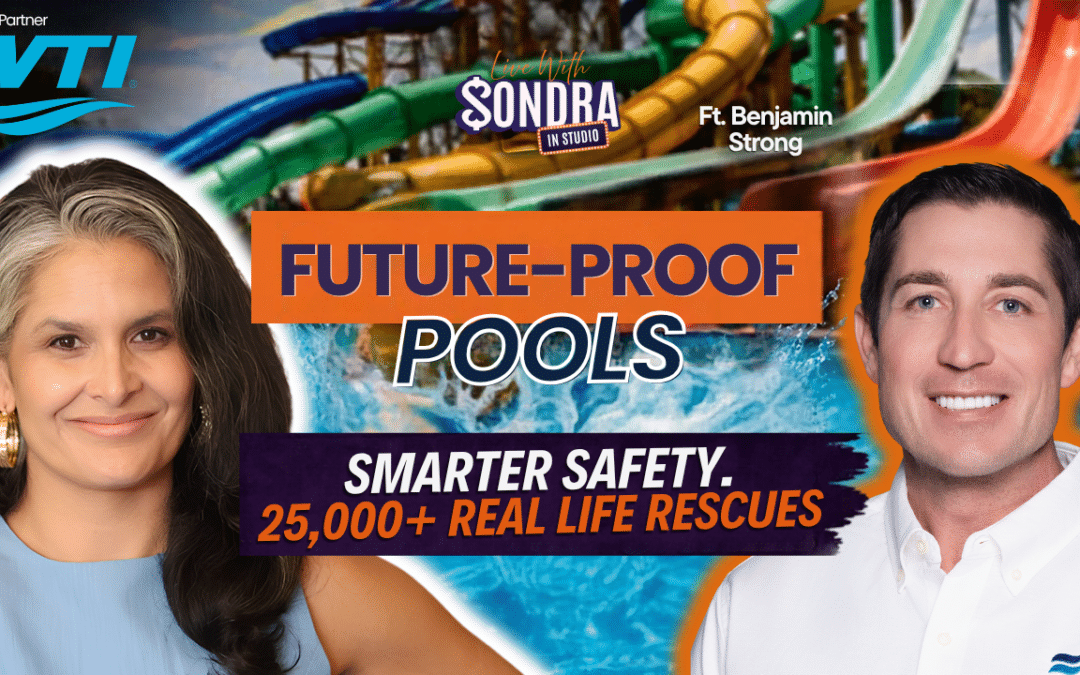
Ft. Benjamin Strong, COO of Ellis Aquatic Innovation & Ellis International
This in-studio episode features Benjamin Strong, COO of Ellis Aquatic Innovation and Ellis International, on how a legacy lifeguard-training brand is reinventing aquatic safety with AI-powered tools, real rescue data, and lifeguard-centered design. Ben shares how the EAV System (Ellis Aquatic Vigilant System) tackles staffing challenges, complex attractions, and tech skepticism—enhancing lifeguards rather than replacing them.
“If you don’t protect the people at your facility, you’re in trouble from the get-go.”
– Ben Strong, on the non–negotiable priority of guest safety
Overview
This conversation between Ben and Sondra is a playbook for operators who are feeling:
- Overwhelmed by staffing gaps and operational friction
- Skeptical of AI and surveillance but curious about real safety gains
- Concerned about incidents, near-misses, and liability in the water
You’ll hear how a 40+ year legacy brand is:
- Using real-world rescue data (25,000+ documented rescues) to rewrite training and protocols
- Building human-in-the-loop safety tech that amplifies lifeguards instead of replacing them
- Turning failures and uncomfortable truths (like sleeping guards and hesitation on stand) into fuel for industry-wide improvement
For aquatic directors, GMs, and safety leaders, this episode is a practical look at what “next-generation safety” actually looks like on deck.
1. From Lifeguard to COO: A Career Built in the Water
Ben’s credibility starts on the stand, not in a boardroom.
- Started as a junior lifeguard at 14 in Indiana, then lifeguard at 15
- Worked his way through almost every role at Ellis: lifeguard, supervisor, manager, aquatic director, instructor, instructor trainer, and beyond
- Has spent ~20 years inside Ellis and the aquatic industry, mentored by some of the founding figures of the modern waterpark world
What comes through:
- This isn’t a “tech founder looking for a use case”; it’s an operator building tools for operators
- The culture of mentorship and high standards at Ellis is a throughline in how they think about safety and innovation
“They set those standards really, really high… and that expectation of zero drownings in the aquatic community… does put a lot of pressure, but it also gives us a good opportunity to realize that there’s always room for improvement.”
Executive takeaway:
Your best innovation lens often comes from people who’ve lived every operational layer—especially when the stakes are life and death.
2. Why Aquatic Safety Has to Evolve Now
The industry has changed—but many safety practices haven’t.
Ben calls out several converging pressures:
- Staffing crises
Parks can’t run all attractions or have to shorten hours because they can’t staff safely. - More complex attractions
From lazy rivers to advanced slides and surf attractions, operational complexity has exploded in 20 years. - Rising expectations
Guests assume near-perfect safety; regulators and communities have zero tolerance for preventable incidents. - Cognitive overload for guards
Hundreds or thousands of guests, unpredictable behavior, heat, fatigue, rule enforcement, parent assumptions (“the lifeguard is watching my kid”).
“The job duty of a lifeguard is so difficult and challenging… it is tireless work. It’s exhausting… and the demands of that job are only increasing.”
Executive takeaway:
If your operations, training, and tools still look like they did 20–30 years ago, you’re not just “behind”—you’re out of alignment with the real risk profile of today’s parks.
3. The EAV System: Tech That Keeps Lifeguards in the Loop
💡 Core idea: Technology as an extra set of eyes, not a replacement.
Ben introduces the EAV System (Ellis Aquatic Vigilant System):
- Uses technology to act as an additional viewpoint over the water
- Designed to assist lifeguards with recognition and response, especially in crowded, chaotic pools
- Focused on:
- Detecting abnormal behavior or distress
- Alerting guards to “pay attention over here” in real time
- Removing seconds of hesitation and uncertainty
Key clarifications Ben makes over and over:
“This isn’t about replacing guards in any way, shape, or form. It’s about how do we utilize technology so that we can operate them the way that we need to… and at the same time, enhance safety.”
“The system does not work without the lifeguard being regularly involved.”
The design is explicitly:
- Human-centered and lifeguard-centered
- Dependent on humans for response, care, and follow-up
- Built to reallocate lifeguard focus and effort, not eliminate roles
Executive takeaway:
If your team is afraid that tech = job loss, reframe it: the winning systems remove cognitive overload, hesitation, and blind spots, so humans can do the work only humans can do.
4. Data, Failures & the Moral Obligation to Learn
📊 One of the most powerful throughlines in this conversation is data + humility.
Ben explains that EAV has recorded and documented:
- 25,000+ real rescues, across:
- All ages, body types, and backgrounds
- Multiple attraction types (lap pools, wave pools, lazy rivers, slides, etc.)
That data now feeds:
- Redesign of training content and curriculum
- Better understanding of:
- What drowning actually looks like (vs. movie stereotypes)
- Real-world timelines of distress, recognition, and response
- Improvements in ride design, guard protocols, and operations
Critically, Ben pushes against the instinct to hide failures:
“Historically, in the past, people wanted to take that failure and box it up and package it and hide it away, and the reality of it is, it really should come to light… so that those problems can be fixed and repaired and prevented into the future.”
And he reframes the ethics of safety tech:
“If you can take the learnings from all of those previous incidents that happen and create a tool or a piece of technology to prevent that, you have a moral obligation to do that.”
Executive takeaway:
In high-stakes environments, data isn’t surveillance—it’s responsibility. You can’t meaningfully reduce risk if you’re not willing to see, measure, and learn from what’s actually happening in your pools.
5. What the System Reveals: Vigilance, Hesitation & Accountability
🎯 With EAV running, parks are discovering things they never would have seen.
Examples Ben shares:
- A lifeguard asleep at the top of a family raft slide, caught on system video.
- Measured 11 seconds of hesitation on average:
- Time between a lifeguard recognizing distress and actually moving.
- Those 10–11 seconds are “life critical moments.”
Beyond catching issues, they’re using the system to:
Build self-accountability by piping metrics and clips back to guards
Gamify vigilance with rewards, metrics, and performance feedback, especially effective for the 16–25 age group
Show guards exactly:
- What real distress looks like
- What happens when they hesitate
- Why instant response matters
“If you don’t show somebody what you are looking for, it makes it really hard for them to identify and then go in and practice.”
Executive takeaway:
The combination of video evidence + performance metrics can transform training from abstract rules into visceral, behavior-changing feedback—for both individuals and whole teams.
6. Overcoming Tech Skepticism & Infrastructure Gaps
⚙️ Ben and Sondra both acknowledge a harsh reality: many parks are drowning in outdated processes and fragile tech.
Challenges they highlight:
- Operators worry that new systems will add work, not remove it.
- Many facilities were never wired or architected for modern, connected systems.
- There’s confusion and sometimes vaporware in the market:
- Vendors promising “drowning detection” without real, verifiable capabilities.
- Early external tech partners didn’t understand aquatic realities:
- No tolerance for latency, lag, pixelation when seconds matter
- Complex variables like glare, turbidity, theming, crowding
Ellis’ pivot:
- They brought development in-house:
- Learned networking, fiber, AI, video, infrastructure themselves
- Kept a few expert partners but owned the core understanding
- They promote radical transparency in sales:
- Encourage prospects to visit live parks using EAV
- Let operators talk to existing clients without Ellis in the room
“Any entity that doesn’t invite you over to see a system within an active park and allow you feedback from the park directly without their involvement, I would question.”
Executive takeaway:
When evaluating mission-critical tech, insist on proof in live environments—and expect vendors to be open to scrutiny, site visits, and operator-to-operator conversations.
7. Embracing Change Before It’s Too Late
🔁 The episode closes on a clear message: change is non-negotiable.
Ben’s advice to parks that are overwhelmed or behind:
“Don’t be afraid of change. Welcome change because it’s the only way to improve for the better. And don’t be afraid to try something new.”
And the warning:
- Facilities that refuse to evolve—operationally, technically, and culturally—
are already: - Struggling to staff
- Cutting hours
- Or closing entirely
“The industry is changing whether they want it to or not. So you got to get on board at some point.”
Sondra ties it to a broader leadership principle:
- Comfort is a dream killer.
- In attractions, staying comfortable doesn’t just cost growth; it can compromise safety, trust, and survival.
Executive takeaway:
If your operation feels “fine,” that’s your signal to inspect harder, not relax. The next decade will reward operators who intentionally evolve safety, tech, and guest experience together.
Watch & Listen on the Go!
Listen to Live with Sondra In Studio on your favorite platforms including: LinkedIn, YouTube, Instagram, TikTok and X!


In-Studio Series Partner: Water Technology, Inc. (WTI)
Standout experiences don’t happen by accident. They’re designed that way. So if you’re serious about building something people talk about, film, and come back to, go to WTIWorld.com and see what Water Technology, Inc. is doing around the world. Be a destination.
#YourWorldinWater
Episode Transcript
Introduction to the New Era of Aquatic Safety
0:05
You need to feel, see, and touch. Yes. Right. To truly understand. And when
0:11
we’re talking tools that are life safety, there’s nothing greater. Like
0:16
that’s where you spend your time and effort to understand because if you don’t protect the people at your
0:22
facility, you’re in trouble from the get- go. Yeah. This is fascinating stuff. I think what you guys are doing with regards to
0:29
technology, the steps that you’ve taken to understand how to build what’s actually going to work for these parks
0:36
and then implement it in ways because you have been through many generations
0:41
in the aquatic industry. Welcome to Live with Sandre. We’re living in a moment where the attraction
0:47
industry is being pushed forward faster than ever before. AI, data, automation,
0:53
technology is moving at speeds we’ve never seen before. But underneath all of that, there’s something even bigger
1:00
happening. Legacy brands, the companies that help build the industry, are now
1:05
being asked to evolve in real time, to move faster, to rethink operations, to
1:11
modernize without losing the trust and foundations that made them respectable
1:17
in the first place. And that’s not just business challenges. It’s leadership
1:23
challenges. If you’re thinking about what the industry is going to become in 10, 20, 30 years from now, today’s guest
1:30
is living that reality every day. Today I’m joined by Benjamin Strong, COO of
1:36
Ellis Aquatic Innovation and Ellis International. Ben literally grew up
1:41
inside this industry. He started working in aquatics at just 14 years old,
1:46
learning from many of the pioneers who built the modern aquatics world from the ground up. Today, he’s leading the next
1:54
evolution of that legacy, scaling high techch, datadriven life-saving systems
1:59
worldwide. But what makes this conversation interesting isn’t just technology. It’s the tension between
2:06
honoring the past while building the future. Ben, welcome to Live with
2:11
Sandre. Ben, welcome to the show. I’m excited to be here. Thank you for
2:16
having me. Thank you for for coming out here. Well, I’m hoping you’re okay with me just kind of jumping right in. 14 starting at 14
2:24
years old in this industry. Yeah. And uh I know that this probably just been a
2:30
wild ride for you and and such an amazing journey, but I’m hoping maybe you could stop uh or start us off with
2:38
understanding a little bit about who you are, your companies for those that maybe
2:43
don’t know, and maybe a little back history, backstory.
2:48
Yeah, absolutely. So, uh my name is Benjamin Strong. I uh I grew up in uh
2:55
the middle of the cornfield area of Indiana, Anderson, Indiana. And uh I’ve
3:01
I’ve always had a huge passion for aquatics my entire life. I was the uh local pool rat doing everything that he
3:08
could to get into the pools when they opened up for the summertime. And uh that eventually grew into a passion of
The Career Journey: From Lifeguard to Industry Leader
3:15
uh entering in when I was 14 as a as a junior lifeguard. Wow. My first opportunity. Um, I was so
3:22
excited, so nervous. Um, but then that developed into a uh lifelong
3:29
lifeguarding career. So I, yeah, I’ve been a lifeguard since my first time was
3:34
15 when I officially passed the first course, was a junior guard at 14 and coached swim clubs, swam on the swim
3:41
team. A very typical, you know, run-of-the-mill career as it relates to relates to lifeguarding. Um,
3:49
I uh left lifeguarding for only a few short years uh while I went to school up
3:54
at Purdue University and then uh quickly after um in 2005 moved down to uh Tampa,
4:03
Florida where uh I worked down there um at the FWC for a little while and then
4:10
um in 2006 I got connected with uh Ellis, Jeff Ellison Associates and uh
4:18
really started what ended up being a lifelong career. Uh it was absolutely uh
4:26
an amazing opportunity. I started as a lifeguard and over the course of 20
4:32
years fulfilled almost every single role in the company from lifeguard to
4:38
supervisor to manager um aquatic director instructor
4:45
instructor trainers you name it. Uh so it’s been a wild ride over the last 20 years and I’m so thankful to have had um
4:53
such amazing mentors all along the way. the uh aquatic and entertainment
4:59
industry is is s is fun. It’s exciting, right? It has a way of sucking you in
5:06
and keeping you in a part of it. Yeah. And uh I’ve made some of my uh best
5:12
friends in the industry. Um and they’ve become family to me. So,
5:17
it’s been all-encompassing and I feel very grateful to be one of those people that have found what they truly love and
5:25
create a lifong career and a passion for it. I love that. And I love that you’re you
5:32
you share a similar sentiment to a lot of people who come on this show that have been in this industry for most of
5:38
their lives, including myself. I haven’t done anything else my entire adult life. But the the interesting thing to me is
5:45
how we all start in these these ways as lifeguard. Yeah.
5:52
In my case, I was I was a game room tech and yeah, you know, an operator, a general manager
5:58
of a family entertainment center. And I never really saw where I was going
6:03
in the industry. And I’m curious if that was something you saw for yourself. Oh, I don’t think I had any idea where I
6:11
would end up at the end of the day. I just always felt that there was always
6:17
an opportunity for growth. There was always a chance to do something new. Um,
6:22
it was or has been an industry I think that you can create those opportunities
6:29
in it as well, right? I mean, most of the time the opportunity is out there.
6:36
You just need to be willing to work hard enough to seize it and to go after it and being proactive with it to get
6:42
there. Yeah, I agree. In fact, I just made a post yesterday about, you know, the uh
6:49
this industry really relies on people bringing value to it and being somebody
6:54
that’s going to do what they say they’re going to do because this is an industry where that’s trust is really important. Oh, it’s huge
7:00
amongst our peers, but then also with the guests, right? Yeah. Um, which kind which kind of
7:06
brings me to one of the the questions that I have with regards to the business
7:11
that you’re in and having learned from industry pioneers, people who have shaped the aquatic industry, you’ve had
7:18
you’ve had that experience and had that time with them and I’m curious if having
7:24
learned from those people if that is something that maybe is a safety net for
7:30
you with the decisions in your company or the decisions that you have to make with regards to the business and where
7:37
you are or if it’s maybe a heavy load to carry when having to make some tough
7:44
decisions for the business because you are COO of this company. I would say it’s a little bit of both.
Mentorship and Culture in the Aquatics Industry
7:50
Okay. Absolutely. Have I benefited from having the opportunity to experience to learn
7:56
from really some of the founding uh individuals of the water park industry.
8:02
I mean, it’s not that old. It’s only been around for about a little over 40 years, right? So, some of the mentors
8:09
that and the people that I’ve met all along the way really developed what that means and really what it means to
8:16
service the people in a safe manner and ensure that everybody walks away
8:22
healthy, happy, and they had a great and enjoyable day. Um, and they set those
8:28
standards really, really high. and they’ve imparted the the the knowledge,
8:35
the understanding, and the skill sets necessary to do that on those around them. And they were always I don’t think
8:42
I met any major leader in the industry that wasn’t a good mentor,
8:47
right? I mean, they they got into it themselves because they had a passion for people,
8:52
those around them, and wanting to serve other people. and that inherently put
8:58
them into a position to be a good leader and a good mentor and they always found
9:03
ways to impart that to those around them. And so as
9:10
I developed and grew as a leader myself and I still have a lot to learn. I don’t think you ever stop learning along the
9:16
way. Um that pressure is there, right? And that service of excellence and that
9:25
high standards of expectations and that expectation of zero drownings in the
9:30
aquatic community of hey everybody has to leave safe, happy and healthy at all
9:37
times and that is your job no matter what. um does put a lot of pressure, but
9:42
it also gives us a good opportunity to realize that there’s always room for
9:48
improvement. And there are a lot of different ways that we can
9:54
there are a lot of different ways that we can use resources around us to
9:59
improve upon that process and procedure, make it more effective. So, as I step into that leadership role, I try to
10:06
always remember, you know, it’s it’s all about the people. Um, it’s all about
10:12
finding new, better, more efficient ways uh to service those that enter into all
10:17
of our parts. Well, and I’m sure that leads to a lot of innovation. Yes. And I’m hoping maybe you can speak a
10:23
little bit to this life-saving technology that you’re you’re also pioneering in the space.
10:29
Yeah. and maybe maybe how that came to be because I think you know having also been in the industry for 25 years we are
10:36
always seeing an evolution of solutions that are needed for operators and I think this question is maybe twofold
Rethinking Operational Friction in Water Parks
10:41
because I’m sure like like like me running a tech company there’s been many times where I go into
10:49
uh one of our parks and realize that some of these parks are not only drowning in operational friction but
10:55
sometimes even system friction and I know that that is something that you want to tackle with this technology.
11:02
Absolutely. I am so extremely excited to talk about this to be honest because it’s been a passion of ours for eight
11:08
years and running and it all came about because at the end of the day at at our
11:14
heart at our core we are we are operators. We are lifeguards. That’s what we grew up doing. And that has
11:21
given us the ability insight to understand all of its challenges, issues and problems. And the reality of it is
11:28
is the industry is changing. Whether we want it to change or not, it is changing
11:34
around us. And those jobs, those important duties and responsibilities that we have are getting harder and
11:40
harder to meet and fulfill. Whether it’s staffing challenges and reduction, the
11:47
quality of staff, uh length of training obligations to it, the complexity of the
11:53
attractions. Think how much they’ve developed and grown over the course of the last just 20 years alone. It’s been
12:00
immense and it’s been exciting. But all of those changes force you to change
12:06
your training protocols, your curriculum, how you operate. That that whole dynamic has shifted within our
12:14
industry. And the writing was on the wall a decade ago. It’s changing and we
12:20
have to evolve and change with it. And the question was how? How are we going to evolve and change? The reality of it
12:28
is as we sit today, I really do feel this way that, you know, most of the
12:33
world out there from a a lifeguard and safety perspective is really operating
12:39
the same way they did 40 years ago and there’s very little use of technology in
Introduction to the Ellis Aquatic Vigilant (EAV) System
12:46
the safety arena. Yeah. which is kind of crazy because if you look at every other industry out
12:52
there, they’re endop they’re adopting these high-end technologies to improve
12:57
efficiencies uh across the board. And I really felt that we were being left out
13:03
in the dark. And there are numerous numerous reasons why I think that was happening. But the reality of it was it
13:11
it was. And so I think when we went to
13:16
try to figure out what was the root cause of this, we started to understand that there were little ways that we can
13:22
incorporate existing technologies in other areas or sectors into ours to
13:28
start to help offset some of those challenges and those issues. And that’s
13:33
ultimately where and why we started what is called the EVE system. It’s called the Ellis Aquatic Vigilant System. And
13:41
the purpose of that system is to provide an additional set of eyes, right? An
13:47
additional viewpoint for the lifeguards that are currently out on deck
13:53
responsible for the safety and and of all the patrons that visit the facility
13:58
that enter into the bodies of water and need to exit safely and be watched over
14:04
and protected throughout that entire time. And uh the whole aspect of the ease system is is to be that to be that
14:12
additional set of eyes to assist the lifeguards to improve res recognition
14:18
response aspect of it and to be able to handle those situations efficiently and
14:23
effectively. Wow, that’s pretty incredible. Yeah, that’s pretty incredible. And you know,
14:28
I I I know that oftentimes we hear that, well, is it going to replace all the
14:34
jobs, right? Like that’s a question I get all the time. It’s going to replace all the jobs, but at the same time, what I’m hearing from you is it’s enhancing
14:41
what they’re already doing. It’s absolutely it’s bringing more value to the lifeguarding that’s happening in
Human-in-the-Loop Technology: Enhancing Lifeguard Performance
14:47
these parks. Yeah. In terms of safety and also just protection of the guests, right?
14:53
Yeah. You know, that’s one of the biggest questions that we get faced with all the time. Well, it’s replacing guards. It’s replacing guards. That’s
14:59
not the intent or the objective in any way, shape, or form. It’s to allow us a little bit more flex flexibility with
15:06
how we utilize those team members, right? So that we can be more efficient and effective. And we talked about some
15:13
of those changes that are happening in our industry, the reality that we’re faced with every day. I don’t know any
15:20
facilities on a global scale that do not have staffing issues and challenges. And
15:26
of the last 5 to 10 years, I would say so many times most of those parks, most
15:32
of those facilities and operations can’t operate all of their attractions at the
15:37
same time because they can’t get even enough team members to operate them safely or they limit those operational
15:45
hours. Park district effort park district around this country limit pool hours
15:52
because they physically cannot staff them. So this isn’t about replacing guards in any way, shape, or form. It’s
How the EAV System Supports Understaffed Facilities
15:59
about how do we utilize technology so that we can operate them the way that we need to, the way we want to, the way the
16:05
public wants to, right? And then at the same time enhance safety. The the job
16:12
duty of a lifeguard is so difficult and challenging. It is. I mean, it is
16:18
tireless work. It’s exhausting. You’re out there in the elements day in and day out. You’re dealing with all different
16:25
types of personalities and patrons and guest interactions and the demands of
16:32
that job are only increasing. They’re not lightning, right? And as a result of
16:38
all of those challenges, the lifeguards need a tool to optimize their responsibilities as
16:47
much as possible. They need somebody behind the scenes that can be
16:53
that support. Sure. When they get overloaded and that’s what the system really does help to do. Um
17:00
along with that, it it does help to identify those challenges. It is really
17:06
difficult. It can be really difficult to identify an individual that’s in
17:12
distress when you have a few hundred people or a few thousand people in your
17:18
park and a million things are going on and you’re trying to identify that one
17:23
individual in the mix of thousands, right? And when signs and symptoms of
17:30
distress vary greatly, having a system that can help identify
17:37
an alert and say, “Hey, pay attention over here. There’s something not normal.
17:42
There’s something not right.” Alert, focus over here. That’s a huge valuable
17:48
tool. And I don’t know why anybody uh that is interested in safety would shun
17:53
that potential. Sure. And I appreciate you taking us through that scenario because that was a question I had for you is like what does
18:00
that look like? But that was a great visual on, you know, being able to manage in such a a a huge situation.
18:07
You’re right. 500, you know, you have hundreds of people in a weight pool and and I’ve often thought about what
18:14
that must feel like or um how stressful that is for the lifeguards that are that
18:21
are on duty. I mean, I I have kids uh who I’m in this in I I know I mentioned
18:29
that I started in family entertainment, but my first uh gate master client was a water park.
18:35
That’s how we ended up in water parks. and having visited them and then and then taking my own family, my own kids
18:41
and being very uh aware of situations for my young children that were in these
18:47
pools and and putting so much trust in these businesses and the lifeguards. Um
18:54
I can see so much value in what you are doing with this technology. Now my
19:01
but it does peique my curiosity. Do you know what would keep a water park from wanting to have something like this
19:06
today? Um I think there are a lot of mis mis
19:11
perceptions um about what the system is and its
19:16
intent and like with anything right there’s probably a lot of apprehension
19:22
because of those misperceptions right immediately as you said earlier like hey
19:27
it’s re it’s removing lifeguards well no that’s not the purpose of it right so
19:33
let’s talk about what that purpose is right and we try and to always invite
19:38
individuals within our industry to come see it. It is one of those things a picture is worth a thousand words,
19:45
right? When you come in and see how the system is completely designed, which is all human centered, human in the loop.
19:52
And I’ll change out human to lifeguard in the loop. Lifeguard centered completely. The system does not work
20:00
without the lifeguard being regularly involved. It can help identify somebody
20:08
in distress. It can identify a problem that is happening in a body of water.
20:14
That’s a fantastic tool to use, but it still relies upon the response of a
20:20
individual of a lifeguard to go physically retrieve that individual and
20:25
provide proper care and followup. So, I think it’s because of those perceptions
20:31
that are out there right now that we need to start breaking down those walls and barriers. And I’ll be honest,
20:37
everybody that walks through the door is always immediately blown away. They’re like, “Wow, this isn’t what I thought. I
20:44
understand, right? This does bring huge value.” And it’s not just huge value to
20:49
those that don’t know about its capabilities or what it does. It’s huge value to us. The the Ellis organization
20:56
has been training lifeguards for over 40 years. Over 40 years,
21:02
right? That’s incredible. But we are learning so much more about
21:09
what the drowning process is, what it looks like, the timeline that it happens
Data-Driven Safety: Lessons from 25,000+ Real Rescues
21:16
because the utilization of this technology, it it is fundamentally going
21:21
to change the entire aquatic industry. I have zero doubt about that because we’re
21:27
learning so much more every day because we’re able to now aggregate all of the data, all of that information. We have
21:34
over 25,000 real life rescues recorded and
21:39
documented. These are not staged rescues. These are real people in distress of all ages, shapes, sizes,
21:47
ethnicities in all different types of attractions from your flatwater typical six lane lat pool to your wave pools and
21:56
lazy rivers and flow riders. I mean, all of these different slides that we have out there nowadays, and that information
22:03
and data is critical to the evolution of our entire industry, to the way we
22:09
design rides, to how we respond, to our own training content and curriculum,
22:15
which is currently under review for integration of
22:21
all of those learnings that we’ve had. How do we bring that back and change our own content and curriculum that has been
22:28
successful for 40 years, but the reality of it is it needs to change and evolve
22:33
as you learn more information moving forward. Well, and I think that’s so interesting you brought up the data because I I
22:39
often have this conversation with the parks that I’m working with and and we’re on ticketing side. So, but you
22:45
know, so many of them haven’t had the right information to make decisions. And I think that’s what I’m hearing from you
22:51
right now is that as you’ve developed this program and you’ve been able to learn from the data that’s being
22:56
collected, you’re able to enhance the processes that save lives. And I think it’s I I
23:04
think that that’s um also a big misconception in the industry because a lot of times, you know, we get asked
23:09
about like the data being used for surveillance. And I’m a I’m a big fan of only, you know, we only use the data
23:15
that we we need to enhance the guest experience. Yeah. There’s there’s just things we don’t
23:21
really care about. Yeah. And it doesn’t matter. It’s not going to affect uh the the guest experience. But
23:28
what we do want to collect is data that can help these parks make better decisions. And that’s what I’m hearing from you.
23:35
Absolutely. 1,000%. I I really think our our industry has put up walls and
23:40
barriers in the past because everybody was concerned about data rights, right?
23:46
Was concerned about the the monitoring of individuals. The reality of it is is
23:52
we we need that information to be able to evolve and to figure out how we integrate new technologies to be
23:58
successful. And I think that where we’re headed, there’s so much information,
24:05
connected systems from the the second somebody walks into the park to the
24:11
moment that they leave that there’s so many opportunities to to pull that data and information, analyzing it for that
24:18
safety and health of the guest, right? And that’s where that’s where it all stems from. And without the data sets
24:26
that we have now, we wouldn’t have been able to evolve and change. There’s no
24:32
doubt about it. And I always tell people or patrons when they they ask about the
24:38
system because they do get excited. Initially when we started rolling this out, we thought, man, there’s going to
Overcoming Public Perception and Data Privacy Concerns
24:44
be a lot of apprehension. We’re monitoring everybody in the bodies of water at all times. And then
24:52
once we started doing it, we brought in groups of people. Hey, how do you feel about this? And there was there was no
25:00
apprehension. There was pure and utter excitement. Yeah. And I was a little shocked at first. I
25:05
was like, oh, I thought we were going to get a lot more push back. But the reality of it was and they’re like, listen, you are there to protect our
25:12
children. And when we’re doing a job that you don’t get a second chance, if
25:17
somebody fails at what we do, that’s a fatality. There’s no going
25:23
back. You don’t fix it. You don’t repair it. You know that that is a a loss for
25:29
the the parent, the child, the individual, the park, and the entire
25:34
community. This is a serious thing. Yes. So why would we not want to use that
25:40
data and information to reduce that risk and put as many different layers of
25:47
protection in there as possible because the reality of it is there are still hundreds if not thousands of drownings
25:55
that happen around this country every single year at pools where people are
26:02
responsible to watch those bodies of water. And when we know all it literally
26:07
takes is a few seconds of a parent not paying attention to their child, right,
26:13
where they they run off. It takes a few seconds to go from conscious to unconscious. That’s a serious task at
26:20
hand, right? Or there’s those medical events that happen. a normal healthy
26:26
individual walks in for a lap swim or they think they’re healthy and next thing they know they suffer a seizure or
26:33
a stroke or a heart attack and they slip beneath that water and within a few
26:38
seconds now you have a major serious of event. If you can take the learnings
26:44
from all of those previous incidents that happened and create a tool or a piece of technology to prevent that, you
26:51
have a moral obligation to do that. Agreed. That’s amazing. I love that. And
26:57
you know, I um I love this because I think I I know
27:03
you’ve been a champion for kind of breaking down these barriers where people have wanted to hide or hoard the
27:09
information of things that have happened in the industry that we’re we’re not necessarily proud of because they were
27:15
issues that compro, you know, where safety was compromised or mistakes that happened or like you said, fatalities
27:22
that have happened. But what I I I like about what you’re saying is that we’re
27:27
going to take this information, we’re going to learn from it, use it to make the industry better, safer, more
27:34
reliable, create more trust in all of our communities, and uh and and help our
27:41
lifeguards out, right? Because how many of how many of them are stuck with parents who assume the lifeguard’s
27:47
watching them? Yeah. Because that’s happening, too. Yeah. Oh, more more and more every
27:54
single day. Unfortunately, I think a lot of individuals walk or a lot of parents
27:59
walk into the facilities with that that false sense of, hey, they’re just going
28:06
to deal with it. I don’t have to. I’m off the clock, right? And that puts a lot of other additional stress on our
28:14
team members, right? because it’s it’s not just the in the water aspect of of
28:22
the rescues and the near drownings, but it’s also the amount of rule enforcement that has to happen, right? And and all
28:29
that. So unfortunately I think that is a part you know when we on your earlier
28:34
comment about some of the major failures and the
28:39
data aspect of it I would say that we’re going to take a quick moment because conversations like this just
28:45
don’t happen by accident. Our Live with Sandre series brand partner Water
28:50
Technology Inc. is helping operators around the world turn vision into fully realized aquatic experiences.
28:57
From early concept to master planning to design, engineering, and project
29:02
execution, their team brings together architects, engineers, designers to
29:07
build environments that are intentional, immersive, and built to perform. What I
29:13
love about WTI is this. They don’t just design water parks. They design how
29:19
people experience them. Every detail is thought through. From guest flow to water quality to the emotional
29:26
connection a space creates because great experiences don’t happen by accident.
29:31
They’re engineered. So whether you’re building something new or re-imagined, this is the level of thinking that
29:38
separates good from unforgettable. You can learn more about WTI at
29:43
wtiworld.com. All right, let’s get back into it.
29:49
I always tell people I I personally I learn more from my failures than I do my
29:55
successes. We never want those failures to happen as human beings. I mean, nobody wants to fail, but when they do,
30:04
it’s always important for us to go back and methodically go through why did that
30:09
happen in order to learn from it and prevent it moving forward in the future.
30:14
And historically in the past, people wanted to take that failure and box it
30:20
up and package it and hide it away. And the reality of it is it really should
30:26
come to light. It should come to light so that those problems can be fixed and
30:32
repaired and prevented into the future. And the system does do that.
Uncovering Operational Inefficiencies with Technology
30:38
Yeah, it does do that. And I will give you an example. I you know this is one that
30:44
you’re like oh why would you say this but it is it was we put a system into one of our facilities that we’ve been
30:50
operating for a very long time and we went to go live with it and we flipped
30:56
the system on one of the days of training just a couple first days and one of the first things that we see is a
31:02
lifeguard sleeping on the top of the family raft slide passed out just easing away right
31:11
Yeah. And it’s like these are the things that by having a system like this, it brings
31:19
to light the deficiencies that happen. Whether they be with an individual team
31:25
team member, whether they be with the training component, whether they be with how we’ve designed the operator
31:32
protocols or parameters, whatever it might be. And and we always welcome that because that’s how we learn. That’s how
31:39
we evolve. Yeah. And you know, as somebody in tech and also having when I started in this
31:47
industry, we were moving people from like Casio cash registers to computer systems that were managing cash control.
31:54
And the first thing always that happened in the beginning was you’d find the people who were skimming off the top,
32:00
right? They were taking the cash and because they didn’t understand that the system was watching Yeah.
32:05
Not just watching them, but watching every keystroke. Yeah. And and and I think that’s what I hear from you is that you’re uncovering
32:13
things that are happening probably in these parks that they’re just not aware of. And maybe they’re inefficiencies in
32:18
their team or maybe they’re training. I I mean I don’t know how you train somebody not to fall asleep on the job.
32:25
But that’s a that’s a good thing to discover though that’s happening. Yeah. you know there’s we have ways
32:33
within the system for self accountability and I always think that’s really really important
32:38
right so we’ll even take um some of these metrics and some of these video
32:44
feeds and some of these alerts and we pipe it right back to our own lifeguards
32:49
right and we say hey you know you’re not being as vigilant as you should to be so
32:56
step it up right re-energize yourself or hey communicate ate effectively so we
33:02
can swap out other team members so that we can still meet that standard or expectation and then we provide um
33:10
reward programs and motivational tools around that right there’s we’re we’re
33:15
working on some new ways but I’m a huge advocate that if you can even gify
33:21
certain aspects of it it creates a huge motivational tool especially for the age
33:26
group we’re talking about right most of our pipe guards are between the ages of
33:32
16 to 25 across the entire industry. You know, you have outliers and leaders and
33:37
everything, but this is that group that is very motivated by those type of
33:43
items. And we’ve seen some huge success with that selfaccountability of it. And
33:49
now that we can actually articulate how well we are doing at the job and we can
33:57
score some of those items. Now it’s in front of the their own face and saying, “Oh, wow. We did great. Like we really
34:04
stepped it up.” When we can get to the point where we’re at now, where we can actually articulate
34:12
how long it takes to identify a guest, how long it takes for the guard to once
34:18
they identify it to react, and then how long it takes to them to get to that
34:24
guest. I mean, those are all metrics in the old days. There’s no way we had no
34:30
we would we wouldn’t have been able to identify that on average it takes us about 11 seconds of hesitation. That’s
34:37
meaning when I have a person a lifeguard here that has recognized I have somebody
34:42
in distress in my water and we teach and articulate if you don’t know go right
34:48
you go in immediately if you even hesit or if you even suspect somebody’s in distress right you go. But what we’re
34:55
finding is our guards are sitting there and they’re in this disbelief like
35:00
that’s not happening. They’re okay. They’re just playing. And they’ll sit there for another 10 more seconds before
35:08
they respond. Those are life critical moments. I believe it. I’ll tell you, I had an
35:14
experience recently on one of the uh one of the uh IAPA events where we were at a park and uh somebody came running and
35:22
they were choking and one of the the people in our in my com in our in the
35:28
company that we were with or uh in in that was in the group that I was with jumped right to it and helped the guy.
35:34
But I’ll be honest, even I hesitated. Yeah. Like it took me a second to recognize
35:39
what was happening. I mean, I’m not in the job of safety, so I would expect that. But I my my point in telling this
35:47
story is is that the coaching that this tool is giving people who maybe don’t
35:52
realize that they are hesitating. Hesitation, I think, is a normal human behavior. It’s that disbelief. It’s
35:59
like, oh man, what do I do now? And the only way to get rid of that is through
36:05
education and practice. the individual that jumped right in has
36:10
probably practiced that scenario over and over and over and over, right? But a
36:16
new individual that’s a brand new lifeguard coming on for their first day or their first season of operations,
36:23
we constantly have to go through ongoing training, not just after the lifeguard, but ongoing inservice training to get
36:30
them to understand that you don’t hesitate and here’s what happens if you do. Yeah. And that’s a huge component
36:37
that this system brings to the table. We can now show the guards what happens if
36:44
you do hesitate, right? We can show them what that looks like. And that has been
36:51
a gamecher for us. We have a massive library of all of the different ways
36:57
that people drown. And it isn’t this help me, help me, help me, you know,
37:04
shouting for the lifeguard, sitting above the water. It doesn’t look like that at all. Right? But if you don’t
37:10
show somebody what you are looking for, it makes it really hard for them to
37:17
identify and then go in and practice. Yeah. No, I think training is huge and
37:23
continuing to train is super important. I mean, even my team, we say we train every day, and we do, you know, we have
37:29
a program that we train on the stuff that we need to know um for for for our
37:35
scope of work in the industry. But I think it’s super important that that the parks do remember that training is such
37:41
a huge part of being able to create these experiences, good, positive
37:47
experiences for the guests that are coming into the park. And I love that you have you and Ellis have always been
37:53
so focused on the training aspect of our industry. I um I’m curious,
38:00
you know, who doesn’t want this? Is there anybody that or is there anybody that’s just
38:06
if they’re having an issue right now that you would say, “No, you need to be looking at this.” Like what is that
38:11
thing? It’s not necessarily that they don’t want it, but that thing that makes them have that light bulb moment where
38:17
we need this. Um I I would say
38:23
unfortunately I think a lot of people don’t want to know all of the problems.
38:28
Yeah. Right. Um it’s it’s a hard thing to overcome.
38:34
Sure. And to to to get over, right? And I think it really is um people do have
38:42
apprehension about what is the public’s perception of this going to be and there
38:48
were absolutely you overcome that through education. Um you overcome that
38:54
with welcoming people in uh behind the scenes. We do that all of the time. We
39:02
work with different um uh county health departments and uh different boards and
39:09
associations and we always we open everything. We open the books. We want
39:14
them to see the process, the procedure, the training, the statistics and we are happy to share those statistics globally
39:22
with everybody because it’s through that education that we overcome those fears.
39:27
Sure. And also I think like it’s okay to realize that you need to get better.
39:34
Yeah. We have to continue to develop as an industry and that includes learning
39:39
about technology, right? We were having a conversation a little bit earlier before this before we started the show
39:45
and I want to kind of go there a little bit about how I mean I know I know from where I’m sitting it’s been very
39:50
difficult to educate operators on technology because they’re not technical people and that’s not good or bad
39:58
because they are you know I I like to always say like operators of businesses oftentimes are
40:04
great at the thing that they do really well and sometimes we don’t look at the things that we don’t do Well, uh,
40:11
because I mean, who wants to do that? I It’s a natural human behavior, I think, to not want to look the things you’re
40:17
not good at. Yeah. No, absolutely. Um,
40:22
yeah. Listen, I think our industry is um,
40:28
how do I say this? We have, most everybody in our industry is people
40:34
focused, right? We’re we’re out there involved in the commotion. We’re very handson in that group. And a lot of
40:41
times when people think that once you integrate technology, it provides a barrier between you and the guest.
40:49
um if it’s crafted and created and implemented in a in the right way, I
40:56
think it’s an additional tool to to merge that together to um to actually
41:04
use that as a as a uh as a tool to how do I want to put this? I’m not phrasing
41:11
this correctly, but uh I would say to to invite them in and to to kind of create
41:17
a better partnership with the guests that enter into the facility. Um and it
Bridging the Gap: Getting Operators to Adopt Tech
41:22
it just takes a lot of time, too, right? Yeah. Everybody has so much on their plate
41:28
already when they hear, “Hey, I’m going to implement a new technology.” They think how much time and training that
41:36
they’re going to have to do, not just for them, but for the staff and the the local facility, right? what else is that
41:42
going to put onto their plate instead of seeing that as a solution that that’s going to probably optimize or clean up
41:50
some of their own processes and procedures whether it be front gate admissions or operating reports or or
41:57
logs, daily operating reports or chemical maintenance sales marketing.
42:02
All of these technologies can make their life so much easier if they would embrace them.
42:08
I agree. I I I I can’t tell you how often, I’m sure you you probably experienced this too, where you go into
42:15
an operation and they’re completely drowning in
42:20
operational processes that aren’t efficient. That’s a much better way than what I was trying to doing things the the old way, right?
42:27
Because we get that a lot, too. Like, well, we’ve always done it this way. They’re over their heads right now.
42:32
Yeah. Right. and they see that just as adding another thing on top of it instead of finding a better way to do
42:40
their existing process and procedures. And automation automation is going to
42:45
have to happen within certain areas of our industry in order for us to be successful.
42:51
Everybody’s already overworked and underwater as you put it. Yeah, I agree. Well, and I know um I I
42:58
think I think I I saw something about a story when you originally started kind of creating this technology working with
43:06
outside teams that maybe didn’t understand our industry and you know talking about failing
43:12
forward because I’m sure that led to the iter I mean I’ve been there.
43:17
Yeah. I mean there’s I’ve built so many things that didn’t work. Yeah. In terms of technology in the in the
43:23
parks I built this thing called park tabs one time. Okay. And I loved it. It was like my favorite thing, but nobody wanted to use it.
43:29
Yeah. It was like a parkwide tabbing system. It just never really took off. And now
43:34
we’re we use mobile ordering and other other pieces of technology, cashless systems. But at the time, I thought,
43:40
“Oh, this is brilliant.” But, you know, sometimes those ideas aren’t a great fit for the industry or maybe we’re
43:48
not dealing with and and I think this speaks to the AI. You know, so many people say to me all the time, “What are
43:54
you going to do when AI starts coding everything?” Well, it’s going to be very difficult to
43:59
do without somebody who understands the operational processes that need to happen or the safety side of the
44:06
business. Like, it’s going to take people of this industry to work with the AI to even make it work for us.
44:14
1,000%. I couldn’t be more on your page. Um, yeah, I I’ll be honest. When we
44:19
first went down the path of trying to develop the EVE system and to understand
44:25
all the components that would need to come in in order to make that happen, we first initially took the concept or
44:33
ideas and we took it to other titans
44:38
in the around the globe really and we said, “Hey, here’s our idea. Here’s what
44:43
we want to do. How can we make this happen?” And I will say for the first few years it
44:51
was extremely challenging because they would come in and they would do an analysis of of pieces of components and
45:00
pieces of the technology that would need to be implemented at the properties and and we did it and we followed their
45:05
advice and we followed their guidelines and they never quite could grasp or
45:13
understand the severity of what we do the fact that you know within our um
45:21
video surveillance aspect and system that we we can’t afford a 3 second lag
45:28
in video feed or any downtime or latency or pixelations because when I only have
45:36
a few seconds to get to that individual in the first place those things are critical failures from the get-go and it
45:44
was so hard to get them to understand all of the nuances and challenges that
45:49
we deal with as lifeguards from glare, water turbidity, patrons, themings,
45:54
attractions, like it they just became overwhelmed and it was
46:00
a lot of failures. We had a lot of failures and I’m not afraid to say it along the way in those learning
46:05
opportunities to the point that we said enough. Like we understand our industry.
46:12
This is our lifeblood. this is what we do day in and day out. We’re going to
46:17
learn that side of the industry. And we did. And we learned all about conduit
46:24
and cabling and fiber and networking and video surveillance and AI and coding and
46:30
technology and all of those other things. And we’re still learning every single day. Um, and we we still have
46:37
some great titans in the industry and partners that are that are guiding us along that track. But we decided to
46:43
bring it all in house because we understood the ramifications of what
46:49
happens if that does not work. Yes. At all times. I mean, I think it’s interesting because
The Future of Aquatic Infrastructure and Innovation
46:54
a lot of the tech industry doesn’t necessarily understand wet chaotic environments with thousands
47:02
of people. I I’ve been there too. you know, even having to put my developers behind a ticket
47:09
counter or a food stand where you’ve got lines of moms and hangry kids and and how mission
47:15
critical it is for those businesses to have a smooth process. Yeah. And that’s everything
47:20
and and that the technology should be supporting that, not getting in the way of it. And I
47:26
think that’s I think it’s it’s it’s a it’s a great share to say that there are
47:31
failures that happen in technology because I think that many of our parks are seeing failures in their technology
47:37
that they currently have today and they just need to find the right partners. Yeah. And it it is it is finding the
47:44
right partner. Um a lot of the existing parks out there the infrastructure wasn’t set up in the first place to
47:51
adopt all of these new technologies. So it’s almost going back to the very beginning and looking at that
47:57
infrastructure um implementing it and then as you said finding the collective partners that can
48:03
work together because the reality of it is a lot of these systems do need to connect to be successful. The more they
48:11
that they can connect and talk to each other the easier it’ll make the operators the the faster the flow
48:18
through will happen with the guests. Um, and you know to to get to a really good
48:24
point and there are just like within ticketing within our industry, there are
48:31
operators out there. There are people that are claiming that they can do true
48:36
drowning detection. We’ve been through the industry forward
48:42
and backwards and left and right so far and there are a lot of misconceptions as
48:48
to what that means out there and that is a that’s a challenge for us as well too
48:54
to to get them to understand what that really means. Um and how limited
49:04
yeah some of those other systems really are out there. Um, and they they all
49:10
have value in their own ways. So I I’m not trying to lead any negativity here.
49:16
And they’ve all from their the vapor wear is real. Yeah. I mean, I’ve been in technology for 25
49:21
years. Yeah. That’s a real thing. It is. And the people who end up
49:29
with the having to carry the bag when the mistakes happen. Yeah. Are these parks.
49:34
Very true. Very true. It’s a it’s a hard lesson to learn. Yeah. Um and so I always try to encourage
49:42
individuals when they’re going out and looking for systems for their parks, no matter what they are, what they are, to
49:48
do their due diligence. Yeah. And any entity that doesn’t invite
49:54
you over to see a system within an active park and allow you feedback from
50:02
the park directly without their involvement, I would question. Yeah, I would question because I know when
50:10
anybody is ever interested in the EVE system, don’t talk to me. You talk to
50:15
me. I’ll talk to you anytime you want to. I want you to go to this facility,
50:20
any of our facilities to be honest, and our clients will open their doors, invite you in. You need to go see it
50:26
directly yourself and hear from them first. Yeah. Right. It needs to be that open book
50:32
policy. And not everybody’s like that, unfortunately. Not everybody’s like that. You know what? I’ve been in the RFP process or
50:38
even just the bidding process so many times where um I’m told that somebody does something and I’m like, “Well, have
50:44
you actually seen it?” Yeah. Yeah. And you find out they never saw it and
50:50
it never existed. I heard from somebody else. Yeah. Or I saw, you know, a clip. Well, yeah.
50:56
You need to feel, see, and touch. Yes. Right. To truly understand. And when
51:02
we’re talking tools that are life safety, there is there’s nothing greater. like that’s
51:10
where you spend your time and effort to understand because if you don’t protect the people at your facility,
51:17
you’re in trouble from the get-go. Yeah. I mean, it’s literally life and death, right? So, you know, I uh Yeah,
51:25
this is fascinating stuff. I think um I think what you guys are doing with
51:31
regards to technology, the steps that you’ve taken to understand how to build
51:36
what’s actually going to work for these parks and then implement it in ways I mean you’re great candidates for
51:42
implementing this stuff because you have been through many generations in the aquatic industry and then also um a
51:51
legacy company that’s proven and proven success. It’s been around for a
51:57
long time and I really appreciate what you guys have have done for the industry
52:02
and what you advocate for and and how you help all of us do what we do. Well, we’re extremely passionate about
52:08
what we do and and it’s not just because of us. We we have phenomenal partners. I
52:14
mean, we are so blessed um by those partnerships and all of the
52:21
the team members that give countless hours of of dedication to what we do and
52:28
to be in service to the public and the patrons and the the the lives that are
52:35
our lifeguards, the the lives that they change and protect. I mean it’s just
52:41
it it becomes overwhelming and at the end of the day it’s why I do what I do. Yeah.
52:47
I will work all day every day because it’s not just work. It is my passion. It
52:53
is my hobby and there’s I am one of millions within our industry that are
53:00
just like that. They just want to help, right? And it’s it’s a noble cause and
53:06
it’s a great it’s a great industry to be in and I want to change it for the world.
53:12
It’s the best industry. Well, before I let you go, if there is a um if there is
53:19
a park that’s maybe drowning in operational processes or systems that
53:25
aren’t working, you know, what would maybe be one thing that you could give the audience today that they could do
53:30
tomorrow to improve things? What what would be that one thing
53:35
I would say don’t be afraid to go out there and
53:44
find find let’s see how do I put this let’s say don’t be afraid of change
53:51
welcome welcome change because it’s the only way to improve
53:58
um for the better And don’t be afraid.
54:05
Don’t be afraid to try something new. Yeah. Yeah. Don’t be afraid to try something new.
54:10
I I love that. You know, also I think kind of speaks to like don’t just get comfortable. You can’t get comfortable
54:16
in this industry. Yeah. No, you can’t. They’ll You’ll get passed by in a heartbeat
54:23
without a doubt. And there’s a lot of facilities that
54:29
have closed or are closing their doors because they were afraid to evolve. They
54:34
were afraid to change um and are too stuck in their ways.
54:40
The industry is changing whether they wanted to or not. So you got to get on board at some point,
54:45
right? Uh my one of my mentors has a saying that uh comfort is a dream killer. So to
54:54
your point, those parks that are closing down because they’re not willing or open to change, right? It’s super important.
55:00
I mean, we have to be changing as people in the industry. We do. I’ve been I’ve been very lucky because I’ve I’ve had a a mentor
55:07
throughout my life and and Mr. Ellis, Jeffrey Ellis, the the CEO of the brand
55:13
and the company, he’s been about change from day one. He’s always been about
55:19
things have got to evolve. Um, and he’s always been supportive of that. Whether
55:25
it was the introduction of of oxygen and ads into our industry, he was the
55:31
individual, you know, raising the red flag and the banner and pushing that evolution
55:37
because he realized long ago and instilled that into all of us. You have to evolve. Doesn’t matter how good your
55:45
product is, it’s got to continually improve or you will get passed by. Yeah,
55:51
I agree. Well, I’m gonna ask you this last question. All right. Scuba diving. I love scuba diving.
55:58
What is it? You scuba diving, skydiving, or or are you jumping out of planes? I hear I am. I I I love the thrills.
56:05
Kiteboarding, skydiving, scuba diving, anything and all thing extreme sports.
56:11
I’m in. And a big family. 19. Yeah. Nieces and nephews.
56:16
Yeah, we’re racking them up. So, I have 18. A new one just actually announced
56:21
last week. So, we have 19 on the way. So, I’m a big family guy. Luckily, most
56:27
of those have been lifeguards. So, I’ve been able to staff many of pools just from my own family over the years.
56:33
I love that. And moving a legacy brand forward. Yeah. is it’s a
56:39
it’s big uh big shoes that I’ll never be able to fill, but luckily we’ve created a culture and a team uh on a global
56:47
scale that is willing to take up that banner and that challenge and we are excited to do it because it’s it’s more
56:54
than work for us. It’s it’s all of our it’s our lives. It’s our passions. It’s who we are. So, yeah. Well, thank you so much for being
57:00
here and for your time and all that you’ve shared with us and and I know I’m going to be better after this
57:06
conversation. So, I hope the audience feels the same way. Well, I appreciate uh you very much and
57:13
thank you for having me and hopefully we can do this again sometime. Yeah, I hope so, too. All right. Thank you.
57:19
Thank you. We’re entering a new era. An era where destinations are designed for emotion, engineered for scale, measured
57:26
for revenue, and amplified globally. The parks that thrive won’t be the loudest, they’ll be the most intentional. Because
57:33
experience is no longer a decoration. It’s a strategy. And strategy doesn’t
57:38
stop at marketing. It extends into infrastructure, into engineering, into partners that help you choose what’s
57:46
possible to build. That’s why conversations like today and firms like Water Technology Inc., who are
57:52
engineering the next generation of aquatic experiences, matter. The future isn’t just filmed. It’s built to every
57:59
operator, engineer, marketer, and visionary watching. The next decade of
58:04
the industry is being designed right now. Make sure you’re building it on purpose. I’m Sandra and this is Live. If
58:12
this conversation resonated with you, subscribe to Live with Sandra. We bring together leaders building the future of
58:19
destination experiences. Follow, share, and stay in the room.
Recent Posts

Venue AI: Hyper-Personalized Guest Experiences Today
Venue AI: Hyper-Personalized Guest Experiences Today In this episode of Live with Sondra, Maris...

Halloween Special: Unleashing Peak Scares & Digital Hype
LinkedIn Growth: Secrets for Attraction Leaders Norman Gidney, owner of HorrorBuzz.com, joined...
LinkedIn Growth: Secrets for Attraction Leaders
LinkedIn Growth: Secrets for Attraction Leaders Patrick Kling, founder of VI Studios and the Big...