Live With Sondra In Studio
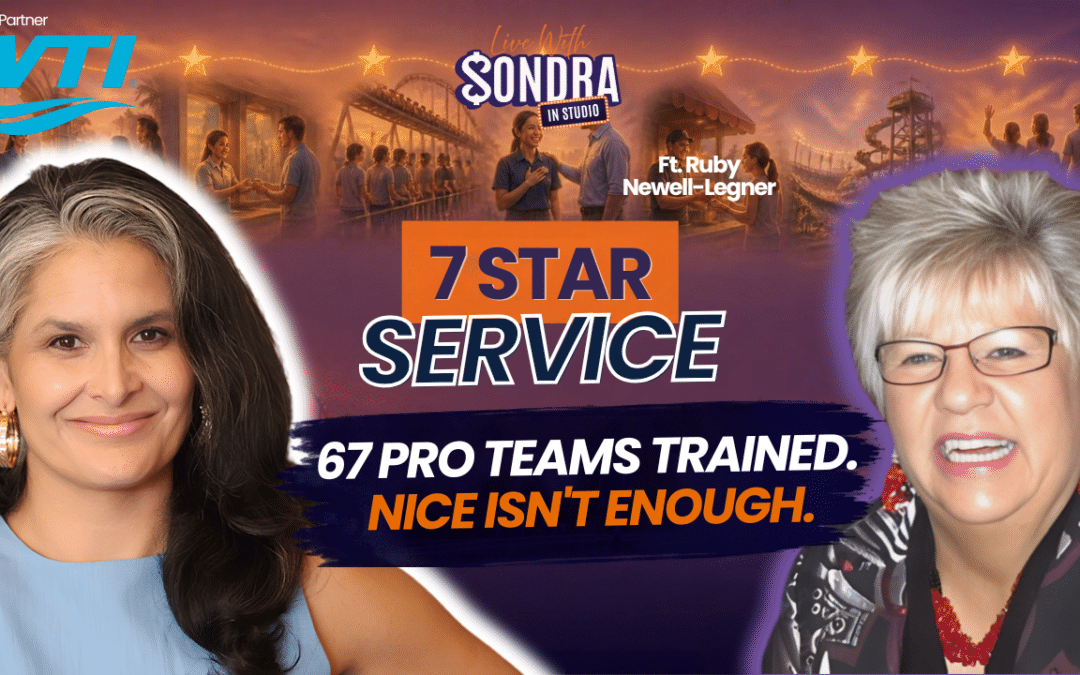
7-Star Service: Designing Experiences Guests Remember
Ft. Ruby Newell-Legner, Fan Experience Consultant at 7 Star Service
Brilliant rides don’t guarantee repeat visits. Experiences do.
Most operators invest millions into hardware—but leave the “human system” to chance. Ruby Newell–Legner has spent decades proving that service can be architected just as intentionally as a slide tower or a wave pool.
“It’s so important that in our businesses we remember that business is about people, from the team all the way to the guests and the people who are having these experiences.”
– Sondra, on why the real product is people, not rides
Overview
Ruby Newell–Legner is Fan Experience Consultant at 7 Star Service, known in our industry as the Fan Experience Consultant. She has delivered:
- 4,000+ programs
- In 26 countries
- Across 238 amusement parks & attractions
- And 67 professional sports teams, plus mega–events like the Super Bowl and the Olympics
In this in–studio conversation, Ruby and Sondra break down how to engineer service so that:
- Staff aren’t just “nice”—they’re deliberate experience–makers
- Leaders don’t sabotage culture from the top
- Guests leave with stories strong enough to become “Thanksgiving highlights”
This isn’t generic customer service training. It’s a field manual for GMs, owners, and senior leaders who want service to show up in revenue, loyalty, staffing, and reputation.
1. From “Nice” to World-Class
“If great service isn’t about being nice, what actually creates a world–class experience?”
Ruby draws a hard line between being nice and designing experiences:
- “Nice” is the entry ticket, not the differentiator.
- World–class service is intentional, consistent, and measurable across every touchpoint.
- The real product is the emotional arc from arrival to departure—not just the ride list.
Operators who stop at “hire good people” end up with inconsistent guest journeys and no way to scale what’s working.
2. Cycles of Service: Mapping Every Moment
Ruby’s signature framework, Cycles of Service, turns vague “good service” into a blueprint:
- She builds a cross–department “shining star” committee—hand–picked frontline leaders in service.
- Together, they map every step of the guest’s journey: pre–visit research, ticketing, entry, amenities, exits, and everything in between.
- For each step, they define specific standards: what staff should do, say, notice, and solve.
Results:
- Service becomes trainable, coachable, and auditable.
- Departments finally see how their actions impact the guest and each other.
- “Wow moments” stop being accidents and start being embedded in the system.
3. Leadership as the Hidden Service Lever
Most calls Ruby used to get were: “Can you fix our frontline staff?”
Her answer: not without the leaders.
Key leadership stories:
- A CEO who walked the venue without acknowledging staff. One simple assignment—“say hello and use their names for a week”—completely changed how the team experienced him, and they noticed within 24 hours.
- A new leader who spent her first weeks interviewing every employee, then stood up in a team meeting and, with no notes, named each person’s strengths and contributions. Immediate trust. Immediate buy–in.
Core idea:
If leadership doesn’t model hospitality, visibility, and respect, no amount of frontline training will stick.
4. Building Problem Solvers, Not Dependence
Ruby focuses on systems that force better thinking instead of more escalation.
Two practical plays:
- The “Two Solutions” Rule
A small sign on her office door read:
“You can bring any problem you want to me, as long as you bring two solutions.”
Staff would literally walk up, read it, step away to think, and return with ideas. Over time, this built a solution–oriented culture.
- “What do you think we should do?”
When calls came in all day with questions, Ruby coached leaders to answer with this first.
Most staff already had the right answer. They just needed permission and confidence.
Outcome:
Teams start innovating at the edge, GMs become less of a bottleneck, and guests get faster, better resolutions.
5. Micro–Systems That Change the Floor
Ruby doesn’t just teach concepts—she collects micro–tactics that change daily operations:
- Silent Manager Signal
In one restaurant, staff put a subtle hand on their heart when they needed a manager. The manager scanned for the cue and stepped in—without any guest noticing distress. - Staff get backup instantly.
- Managers stay on the floor, not buried in the office.
- Guests experience calm, seamless support instead of visible chaos.
- Everyday Recognition as Culture Architecture
Leaders who actively look for what’s working, name it publicly, and tie it to values create a culture where: - Staff feel seen, not managed.
- Service standards feel aspirational, not punitive.
These tiny systems are what make service reliable on a Saturday in July, not just in a training room.
6. Becoming a “Thanksgiving Highlight”
Ruby’s litmus test for a truly great operation:
“If your venue creates the highlight that they share on Thanksgiving Day, you’ve done a great job.”
She calls it the Thanksgiving conversation:
- Once a year, family and friends gather and ask:
“What was your favorite thing you did this year?” - If a guest’s story is:
“You won’t believe what happened at this park…”
then your team has done more than entertain. They’ve created a core memory.
How you get there:
- Design the moments between the first greeting and the final farewell.
- Hire for heart and imagination.
- Train leaders as aggressively as you train frontline.
- Give staff frameworks (like Cycles of Service) that let them turn kindness into craft.
7. What Executives Should Do Next
For GMs, owners, and senior leaders, this episode is a prompt to:
- Audit your guest journey.
Ask: Where, specifically, do we rely on “nice people” instead of a designed standard? - Put leadership in the frame.
Decide what behaviors—from walking the floor to knowing names and strengths—will be non–negotiable. - Install one “thinking system.”
- A “two solutions” rule
- A silent help signal
- A shining–star committee
Pick one, implement it, and measure how it changes decisions and morale.
- Aim to be a story, not a stop.
Reframe your goal from “no complaints” to:
“Did we create a story someone will want to tell?”
Watch & Listen on the Go!
Listen to Live with Sondra In Studio on your favorite platforms including: LinkedIn, YouTube, Instagram, TikTok and X!


In-Studio Series Partner: Water Technology, Inc. (WTI)
Standout experiences don’t happen by accident. They’re designed that way. So if you’re serious about building something people talk about, film, and come back to, go to WTIWorld.com and see what Water Technology, Inc. is doing around the world. Be a destination.
#YourWorldinWater
Recent Posts

From Saigon to Storyland: 25 Years of Spatial Storytelling & the Power of Purpose-Driven Design
Live With Sondra In StudioFrom Saigon to Storyland: 25 Years of Spatial Storytelling & the...

From Battlefield to Stadium: Empathy, AI & the Trillion-Dollar Case for Inclusive Design
Live With Sondra In StudioFrom Battlefield to Stadium: Empathy, AI & the Trillion-Dollar Case...
Tourism Collaboration Strategies: Unlocking Co-opetitive Growth
Tourism Collaboration Strategies: Unlocking Co-opetitive Growth Nicole Mahoney, CEO of Travel...